



Table of Contents Show
Who decides whether a British celebrity is well dressed? Three groups do. The first is the team that creates the look: stylists, designers and make-up artists. The second is the creatives who photograph and frame it, such as photographers and creative directors.
The third is the editors and critics who rank it afterwards. The celebrity is the most visible part of a process involving many people, which is why credit and blame so often land in the wrong place.
What does a stylist do that a celebrity cannot?
A stylist sources or commissions clothes, negotiates loans from fashion houses and arranges fittings. Their choices are visible only through the celebrity wearing them, so responsibility is easily blurred.
In 2026, Katie Price’s make-up artist publicly clarified that her National Television Awards look was not to his personal taste, an unusual moment of a team member separating themselves from the final image.
Tatler’s 2026 list, by contrast, praised the Princess of Wales for elegant, brightly coloured ensembles, including a bold yellow outfit at Royal Ascot. A consistent look of that kind usually reflects consistent decisions behind the scenes.
How Do Designers and Fashion Houses Shape Celebrity Style?
Designers provide the creative foundations for celebrity wardrobes, but their influence extends beyond individual garments.Fashion houses establish distinctive visual identities through fabrics, silhouettes, accessories and seasonal collections. Stylists then adapt these ideas to suit particular performers.
At the 2026 Brit Awards, British Vogue noted Harry Styles in a Chanel pinstripe suit with toe-capped ballet flats and Olivia Dean in a Loewe column gown with floral beadwork.At the BAFTAs, Wunmi Mosaku wore a custom Ahluwalia gown to collect her award. vogueaol.
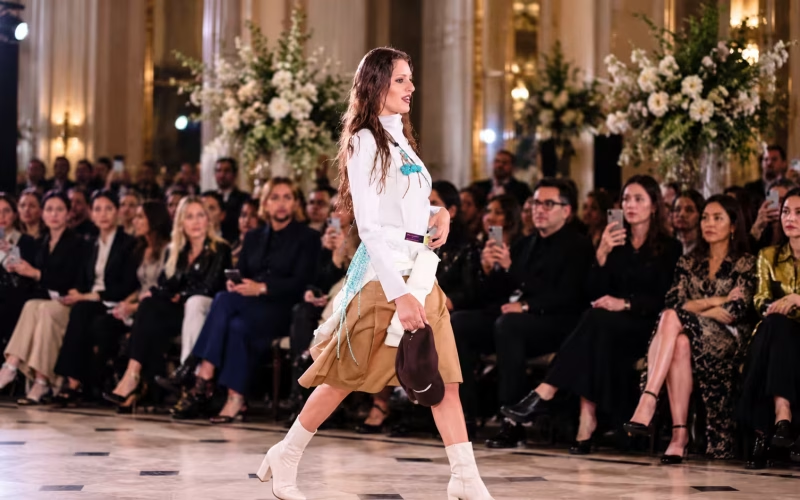
Creative directors matter here too. Chanel’s Matthieu Blazy shows each season in Paris to a front row that, in October, included Dua Lipa, Nicole Kidman, Olivia Wilde and Pedro Pascal.Those guests’ later red-carpet choices are shaped by the house’s direction, which is why a celebrity’s wardrobe is rarely a purely personal statement.
Fashion-house creative directors contribute to this process by establishing the direction of collections before they reach the red carpet. Chanel’s Matthieu Blazy and Burberry’s Daniel Lee, for example, create distinctive design languages that celebrity stylists can interpret for public appearances.
The most effective results emerge when the designer’s vision and the celebrity’s personality complement one another.
How Much Influence Do Celebrity Stylists Have?
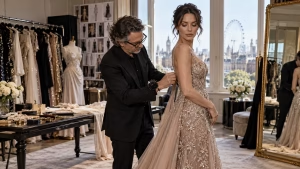
Celebrity stylists do considerably more than select clothes. They work with fashion houses, source or commission garments, arrange fittings and coordinate accessories to create a look that suits both the individual and the occasion.
Their influence is particularly visible when a celebrity develops a recognisable fashion identity over several years.
Harry Styles provides an example. His stylist, Harry Lambert, has helped establish a wardrobe characterised by unconventional tailoring, vintage references and playful combinations of traditionally masculine and feminine clothing.
At the 2026 Brit Awards, Styles wore a black-and-white Chanel bouclé pinstripe suit with the brand’s distinctive toe-capped ballet flats. British Vogue highlighted Lambert’s involvement in assembling the outfit, which complemented the visual direction of Styles’ latest album.
The appearance was not simply about wearing Chanel. It reflected a carefully developed artistic identity.
Stylists must also consider practical details that audiences rarely notice, including comfort, movement and how garments photograph under different lighting conditions.
For performers attending awards ceremonies, these decisions can be as important as the clothes themselves.
Why Do Photographers and Creative Directors Matter?
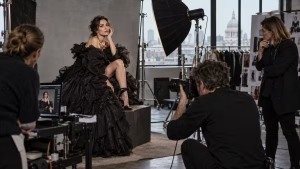
Most people never see celebrity outfits in person. Their opinions are formed through red-carpet photographs, magazine covers, advertising campaigns and social media. That makes photography an important part of how celebrity fashion is understood.
A photographer’s decisions about lighting, composition, setting and perspective can dramatically change how an outfit appears.An unusual silhouette might seem awkward in an ordinary photograph but striking in a carefully constructed editorial image. Similarly, an elaborate dress may lose some of its impact when photographed without the movement or lighting that reveals its details.
British fashion photographer and filmmaker Nadia Lee Cohen is an example of a creative professional whose work demonstrates the importance of visual presentation. Cohen’s photography frequently places subjects in carefully constructed environments where clothing becomes part of a larger visual narrative.
Costumes, make-up, poses and settings work together to communicate an artistic idea rather than simply display fashionable garments. An unconventional outfit may be celebrated in an editorial setting where theatricality is expected, yet receive a very different reaction when worn on a traditional red carpet. The clothes may be similar, but the context changes how audiences interpret them.
Who Actually Decides Which Celebrities Are Best and Worst Dressed?
Editors do. Tatler’s annual list is itself an editorial act, a magazine deciding who defines British style, and its choices are widely repeated as fact. Same-night galleries from entertainment sites work differently, rewarding quick verdicts over reasoning. Neither is neutral, and both influence which looks are remembered.
Why Can the Same Outfit Receive Completely Different Reviews?
Celebrity fashion is subjective, but that does not mean informed criticism is impossible. Different events have different expectations.
The Brit Awards traditionally allow greater freedom for theatricality and individual expression, while the BAFTAs generally favour more formal eveningwear. A dramatic outfit that works brilliantly at a music ceremony may appear inappropriate at a more conservative event.
The celebrity’s established image also matters. An experimental garment can feel natural on a performer known for unconventional style, while the same design may appear disconnected from someone whose wardrobe is usually understated.
Photography adds another variable. A garment’s proportions, texture and movement may look different across images taken from different angles. The strongest criticism explains whether an outfit succeeds in terms of construction, proportion, context and individual identity.
Britain’s best-dressed celebrities are not necessarily those wearing the most expensive or fashionable garments. They are those whose clothes, personalities and creative teams come together to produce a convincing appearance.
And when an outfit fails, understanding the decisions behind it is far more revealing than simply adding another name to a worst-dressed list.