



Table of Contents Show
Behind the queues outside London’s famous names sits a different tier of restaurant — one you’re more likely to hear about from a neighbour than find on a billboard.
These places tend to be small, unbranded, and deeply rooted in a specific community: a family’s home cooking transplanted onto a side street, a shopfront that’s barely changed in decades, a menu that exists because someone missed the food of a country they left behind.
They’re not hidden by accident. They’re hidden because they were built for the neighbourhood first, and everyone else second.
Here are the ones locals actually talk about – and the communities behind them.
How the Best Hidden Restaurants in London That Locals Swear by Reflect the City’s Diverse Communities?
1. Mazal (Camden) – the Hidden Kosher Israeli Spot by the Canal
Tucked into the upper floor of Camden’s Hawley Wharf, a five-minute walk from Camden Town station, Mazal has become known in food and press circles as, quite literally, “the hidden kosher Israeli restaurant in London” – a description that’s followed it into coverage often enough that it’s practically part of the name.
Founded in 2023 by Israeli chefs Neta and Aviv, there’s no grand signage pulling in the Camden Market crowds; you find it because someone already told you it’s there, or because you follow the canal path up past the market stalls and spot a shawarma counter that turns out to be something far more considered.
The food leans into classic Israeli comfort – chicken and lamb shawarma, falafel, schnitzel, hummus plates – served without the polish of its more design-led Israeli cousins elsewhere in the city, and it holds Kosher Federation supervision, a rarity in this part of London.
That’s the point: Mazal exists to feed a community that needs kosher options in an area that doesn’t have many, and everyone else gets to eat well as a side effect.
It’s a good example of how a restaurant’s primary audience – in this case London’s Jewish community – shapes everything from the menu to the opening hours, long before it ever becomes a “hidden gem” headline.
2. Mangal Ocakbasi (Dalston) – Turkish Charcoal Cooking That Predates the Hype
Long before Dalston became a byword for East London nightlife, its Turkish and Kurdish communities were already running charcoal grill restaurants along Kingsland High Street and the surrounding streets.
Mangal Ocakbasi, tucked away on Arcola Street since 1991, is the one locals mention first – simple, smoky, no-frills grilling done properly, in a poky, unlicensed (BYOB) room that looks almost exactly as it did when it opened, with a faded early-90s review still hanging in the front window.
It’s a reminder that “hidden” doesn’t always mean secret – sometimes it just means the rest of London arrived late to a food scene that a specific community built for itself first, and never bothered to rebrand for outsiders.
Worth noting: Mangal has picked up plenty of press attention over the years, so “hidden” here is more about the unassuming façade than genuine obscurity – locals swear by it precisely because the room hasn’t changed to chase that attention.
3. 805 Restaurant (Peckham) – Nigerian Cooking Rooted in South London’s Diaspora
Just off Peckham’s southern edge on the Old Kent Road, 805 is an institution as well-known in Lagos and Abuja as it is in south London – Nigerian dignitaries and celebrities are known to make the trip specifically to eat here.
It’s a pioneer of British West African fine dining: smartly dressed waitstaff, polished porcelain, and a sprawling menu that runs from umami-rich edikang ikong (leafy greens, pumpkin and crayfish stew) and efo riro (spinach stew) to grilled tiger prawns and the house-special Monika fish.
It rarely appears on generic “best restaurants” round-ups aimed at visitors, because it was never trying to be a destination restaurant for them. It’s a neighbourhood one – which is exactly why the neighbourhood, and Nigerians travelling from well beyond it, swear by it.
4. Fish, Wings & Tings (Brixton Village) – Caribbean Flavour in Brixton’s Beating Heart
Brixton Village’s covered market has been a hub for London’s Caribbean community for decades, and Fish, Wings & Tings channels that history through jerk chicken, saltfish and rum cocktails served in a space barely bigger than a living room.
It’s the kind of place where the queue outside on a Saturday afternoon is entirely local – people who grew up around the corner, not people who found it on an algorithm.
5. Kingsland Road’s Vietnamese Strip (Dalston/Haggerston) – a Whole Community, Not Just One Restaurant
Kingsland Road’s cluster of Vietnamese restaurants grew directly out of the Vietnamese community that settled in Hackney from the late 1970s onwards, many arriving as refugees.
Decades later, the strip remains one of the most reliable places in London for pho, bún, and fresh spring rolls cooked by people who learned the recipes long before “Vietnamese food” became a London trend.
Locals rarely pick just one restaurant here – they pick a favourite table, in a strip that still feels like it belongs to the community that built it.
Why “Hidden” and “Community” Are Basically the Same Word?
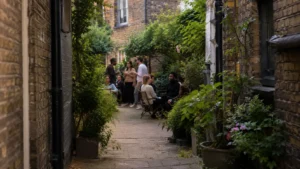
What ties all of these places together isn’t obscurity for its own sake.
It’s that each one was built to feed a specific community first – London’s Jewish, Turkish and Kurdish, Nigerian, Caribbean, and Vietnamese communities – long before it ever needed to impress anyone outside that community.
The menus weren’t designed by committee for maximum appeal; they’re the food someone’s family actually eats.
That’s precisely why these restaurants tend to survive while flashier openings come and go. A restaurant built to serve a real community has a reason to exist beyond food trends. It doesn’t need a viral moment, because it already has regulars.
How to Actually Find Places Like This?
A few habits separate people who stumble onto London’s best hidden restaurants from people who only ever eat at the famous names:
- Follow the community, not the algorithm. If a neighbourhood has a strong cultural presence – a market, a place of worship, a cluster of specialist shops – the best food is usually within a few streets of it.
- Look past the shopfront. Some of London’s best hidden restaurants have deliberately modest signage, limited opening hours, or menus in two languages. That’s not a red flag – it’s often a sign the restaurant is cooking for its community first.
- Ask, don’t just search. Locals still pass these places on by word of mouth more than by review sites. A five-minute conversation with someone who actually lives in the area beats an hour of scrolling.
- Go when it’s quiet. Weekday lunchtimes or early evenings often show you a restaurant as its regulars actually experience it, rather than the version dressed up for a Saturday night crowd.
FAQ
What makes a restaurant a genuine “local secret” in London, rather than just an undiscovered one?
It’s less about how few people know a place and more about who it was built for.
A true local secret is a restaurant that was created to serve a specific community – cooking the food that community already eats at home – rather than one designed to attract outside attention.
The “hidden” reputation usually follows later, once word spreads beyond that original audience.
Are these restaurants still hidden if they’ve had press coverage?
Some of them, like Mangal Ocakbasi and the Kingsland Road Vietnamese restaurants, have been written about for years and are well known within food circles.
What keeps them feeling “hidden” is that the coverage hasn’t changed how they operate – no rebrand, no queue-management system, no menu simplified for a wider audience.
Locals swear by them precisely because they haven’t chased the attention.
Which areas of London are best for finding hidden, community-rooted restaurants?
Camden (Hawley Wharf), Dalston and Stoke Newington, Peckham and the Old Kent Road, Brixton Village, and the Kingsland Road corridor through Haggerston are all strong starting points, each anchored by a distinct community – Jewish, Turkish and Kurdish, Nigerian, Caribbean, and Vietnamese respectively.