



Table of Contents Show
Last updated: 29 July 2026
Electric vehicle drivers across the UK are set to face a new pay-per-mile road tax from 1 April 2028, after the Government confirmed the latest details of its Electric Vehicle Excise Duty scheme.
Under the new system, officially known as Electric Vehicle Excise Duty (eVED), battery-electric car drivers will initially pay 3p for every mile driven, while plug-in hybrid drivers will pay 1.5p per mile.
Hydrogen fuel-cell cars will also face the 3p-per-mile rate. The mileage charge will be paid in addition to normal Vehicle Excise Duty (VED) rather than replacing it.
The Government published its latest eVED policy documents and draft legislation on 13 July 2026, following a consultation that ran from 26 November 2025 to 18 March 2026 and received more than 5,000 responses.
What Are the New EV Pay-per-mile Road Tax Rates?
 The confirmed starting rates from 1 April 2028 are:
The rates will not remain permanently fixed. HMRC says they will be increased from 2029-30 onwards in line with Consumer Prices Index inflation, helping the tax retain its value over time.
For a fully electric car, that means an annual eVED charge of approximately:
- 5,000 miles: £150
- 8,000 miles: £240
- 10,000 miles: £300
- 12,000 miles: £360
A plug-in hybrid covering the same mileage would pay half those amounts in eVED, although its driver may also continue paying fuel duty when petrol or diesel is used.
How Will the EV Pay-per-mile Tax Work?
The Government does not plan to require drivers to install a compulsory GPS tracker.
Instead, when renewing their vehicle tax, motorists will provide an odometer reading and estimate how many miles they expect to drive during the coming tax period.
The DVLA will administer eVED alongside existing VED. Drivers will be able to pay based on their estimated mileage upfront or spread the cost across the year. A later mileage reading will then allow the amount owed to be reconciled against the mileage actually covered.
For vehicles already old enough to require an MOT, existing MOT mileage information is expected to help the DVLA check that reported figures are consistent.
The Government has also ruled out basing the charge on where or when a vehicle is driven, a decision intended to reduce privacy concerns associated with location-based road pricing.
Will Ev Drivers Still Pay Normal Road Tax?
Yes. This is an important distinction.
Electric cars have already been brought into the existing VED system. From 1 April 2025, electric and low-emission vehicles stopped receiving their previous blanket VED exemption.
For the 2026-27 tax year, for example, many electric cars registered from April 2017 onwards are subject to the £200 standard annual VED rate, although the actual rate payable depends on registration date and other circumstances. The VED rates applying in 2028 may be different by the time eVED starts.
The new pay-per-mile charge will therefore generally sit on top of applicable VED, making it misleading to describe eVED simply as a replacement for today’s road tax.
Which Vehicles Will Be Affected?
The policy currently covers UK-registered battery-electric, plug-in hybrid and hydrogen fuel-cell cars.
Electric vans, buses, motorcycles, coaches and HGVs are not intended to be within eVED when the scheme first launches.
HMRC estimates that around 5.6 million vehicles could be affected during the 2028-29 financial year. The Government forecasts the measure could raise about £1.1 billion in 2028-29, increasing to around £1.87 billion by 2030-31.
Why is the Government Introducing eVED?
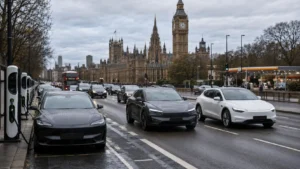 The Treasury says the change is designed to address declining fuel-duty revenue as more motorists switch from petrol and diesel cars to electric vehicles.
Petrol and diesel drivers contribute fuel duty whenever they buy fuel, while fully electric cars do not currently have an equivalent mileage-linked tax.
The Government says the 3p starting rate has been designed to remain below the average fuel-duty cost per mile faced by petrol and diesel motorists while ensuring electric-car drivers make a mileage-based contribution.
There could nevertheless be an impact on EV demand. Government material cites Office for Budget Responsibility modelling suggesting that eVED and related Budget measures could reduce expected EV sales by around 120,000 vehicles between 2025-26 and 2030-31, equivalent to roughly 2% of anticipated EV sales during that period.
Is the 2028 EV Mileage Tax Definitely Law?
The policy has moved beyond the earlier consultation stage: the Government has confirmed its intended rates, start date and operation and has published draft legislation.
However, the Government’s July 2026 policy paper states that primary legislation will be introduced to amend the Vehicle Excise and Registration Act 1994. Further regulations will also be required before eVED becomes operational.
Therefore, 1 April 2028 is the Government’s confirmed implementation date and 3p/1.5p are the announced starting rates, but the remaining legislation must still complete the required parliamentary process.