




Table of Contents Show
A laboratory testing drinking water in London may need to know how much chloride, nitrate or fluoride it contains. Measuring the total dissolved material will not answer that question, because each substance must be measured separately. Ion chromatography provides a way to do this, even when a sample contains a mixture of substances at different concentrations.
The technique is used in water testing, food analysis, pharmaceutical work and industrial monitoring across the UK. It separates substances inside a column, measures them as they leave it and uses reference standards to determine their concentrations. Understanding these steps also helps laboratories assess which equipment and sample preparation methods suit their work.
What Does Ion Chromatography Measure?
Ion chromatography (IC) is an analytical technique used to separate and measure charged chemical species, known as ions.
Anions carry a negative charge and include chloride, nitrate and sulphate. Cations carry a positive charge and include sodium, calcium and ammonium.
A laboratory measuring chloride, nitrate and sulphate in the same water sample needs individual concentrations rather than a combined reading.
Metrohm’s ion chromatography range offers compact instruments for routine testing, alongside separation columns, detectors and automation options for laboratories with different sample volumes and measurement requirements.
The technique is useful when a sample contains multiple ions that must be measured separately. It can also detect low concentrations.
The detection limit is the lowest concentration a method can reliably detect, and it depends on the substance, sample composition, separation method and detector.
Anion and cation analysis generally requires different separation columns. Some instruments accommodate both types of analysis using separate channels, while others measure them in consecutive runs.
How Does an Ion Chromatograph Separate and Measure Ions?
The process begins with a liquid sample. Depending on its composition, the laboratory may filter or dilute it to remove particles or bring ion concentrations within the method’s measurement range.
A measured volume is then introduced into the instrument.
A pump moves a liquid called the eluent through a separation column, carrying the injected sample with it. Inside the column is a material with charged sites that interact with the sample ions.
These interactions cause different ions to travel at different rates, allowing them to separate.
As the ions leave the column, they reach a detector.
Conductivity detection is commonly used because dissolved ions conduct electricity. Ultraviolet-visible detection and other methods are available when the substances being measured require a different approach.
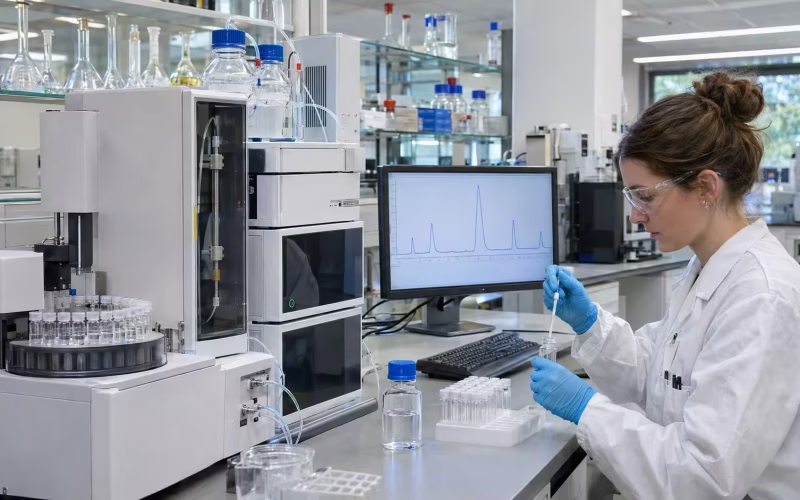
The instrument records the detector response as a chromatogram, a graph showing the separated substances as peaks. Each ion appears at a retention time, the period between sample injection and detection under the selected conditions.
Retention time helps identify an ion when compared with a reference standard.
Concentration is determined from the detector response, often using the area beneath the peak, together with calibration measurements made from solutions of known concentration.
A peak appearing at the expected time does not, by itself, confirm the substance’s identity or establish an accurate concentration. Laboratories also need to check the separation and measurement against their analytical method.
Why Do Some Systems Use Suppression?
In many anion chromatography methods, the eluent contributes to the conductivity measured by the detector. This background signal can make small amounts of the target ions harder to measure.
A suppressor changes the composition of the liquid leaving the separation column, reducing background conductivity. This can make the detector response from the ions of interest easier to distinguish, particularly at low concentrations.
Non-suppressed methods measure ions without this additional treatment. They are suitable for many applications, depending on the eluent, detector and concentration range.
The choice depends on the substances being measured and the required detection limits. Suppression is not necessary for every IC method, and a non-suppressed system is not automatically unsuitable for trace analysis.
Where Is Ion Chromatography Used?
IC serves laboratories working with water, food stores, pharmaceutical products and industrial processes. Although the separation principle remains similar, the substances measured and the preparation required can differ considerably.
Water and Environmental Testing
Water laboratories use IC to measure dissolved anions in drinking water, groundwater, rivers and wastewater. Chloride, fluoride, nitrate and sulphate are among the substances commonly examined.
Published testing standards also specify IC methods for certain substances. ISO 10304-4:2022 describes the determination of chlorate, chloride and chlorite in water with low levels of contamination.
Laboratories must establish whether the method is suitable for the samples and testing requirements involved.
Food Analysis
Food laboratories can use IC to examine certain preservatives, organic acids and mineral ions. Preparation depends on the food being tested, since fats, proteins and other components may interfere with the analysis.
One application is the determination of nitrite and nitrate in meat products. ISO 7158:2024 specifies an ion chromatography method for measuring these substances in meat and meat products.
Pharmaceutical Testing
Pharmaceutical laboratories use IC to measure selected ionic impurities, examine raw materials and test water used in manufacturing.
The method depends on the substance being examined and whether the laboratory must follow a pharmacopoeial procedure or use another validated analytical method.
For laboratories following controlled testing procedures, repeatable separation, documented calibration and suitable reference materials help establish whether measurements meet the required criteria.
Industrial Water and Energy Production
Power stations and industrial facilities monitor dissolved ions in water used for boilers and other equipment. Measuring chloride, sulphate and related substances helps laboratories track changes in water chemistry and investigate unwanted contamination.
Repeated measurements can also show whether concentrations are changing between sampling locations or over time.

What Can Affect the Reliability of the Results?
The composition of a sample can affect the measurement, especially when it contains suspended particles, high salt concentrations or substances that interfere with the ions being examined.
Particles may block the separation column or tubing. When peaks overlap, the concentrations of individual ions may be difficult to determine accurately.
Samples with concentrations above the calibrated range may also need dilution. Filtration or changes to the separation method may be necessary, depending on the problem.
Calibration provides a reference for calculating concentrations. Laboratories use solutions containing known amounts of the target ions to establish the relationship between detector response and concentration.
Blank samples and check standards help identify contamination or changes in instrument response.
Column condition, eluent composition and maintenance also affect separation. Changes in retention time or peak shape can indicate that the method or equipment needs attention.
IC does not measure every chemical substance in a sample. Conventional ion-exchange methods focus on charged species, while other separation modes and detector arrangements extend the substances that IC can examine.
A different analytical technique may be needed when the selected IC method cannot separate or detect the compounds of interest.
When Is Ion Chromatography the Right Choice for a Laboratory?
IC is worth considering when a laboratory needs to measure multiple ions in the same sample or determine concentrations that simpler testing methods cannot adequately resolve.
The number of samples matters too. A laboratory handling occasional water samples may need a compact system with a suitable detector.
One receiving large daily batches may benefit from automated sample handling, although the injection and preparation steps that can be automated depend on the system and sample type.
A method tested only with reference solutions may behave differently with a laboratory’s own samples. Testing representative samples can reveal whether interfering ions, concentration ranges or preparation steps affect the results.
Those findings, alongside the number of samples handled each day, give laboratories a firmer basis for choosing the appropriate column, detector and level of automation.