




Table of Contents Show
If you are wondering why Sadiq Khan is still Mayor of London after more than ten years in office, the basic answer is surprisingly simple.
There is no statutory term limit for the Mayor of London, and Londoners elected Sadiq Khan for a third time in May 2024.
He received 1,088,225 votes, or 43.8% of the valid vote, compared with 812,397, or 32.7%, for Conservative candidate Susan Hall. His current term therefore continues until the next scheduled mayoral election in May 2028.
The more interesting question is how Khan has remained electorally successful despite criticism over ULEZ, housing, policing, crime perceptions and a 2026 poll showing that a majority of Londoners would prefer Labour to field somebody else at the next election.
The answer involves London’s electoral rules, Khan’s geographical coalition across the capital, the candidates who opposed him and the difference between public approval and actually winning an election.
Is There a Term Limit for the Mayor of London?
No. There is currently no limit on the number of terms somebody can serve as Mayor of London.
London mayoral elections normally take place every four years. An incumbent mayor can stand again and, provided they remain eligible, are selected as a candidate and receive enough votes, can continue serving.The possibility of introducing a two-term limit has been debated in Parliament before.
During debate on the Greater London Authority Bill in 2007, MPs and peers discussed proposals for restricting the Mayor to a limited number of terms, but the principle adopted was that Londoners should be able to decide at elections whether to return an incumbent mayor.
The office consequently has no equivalent of the two-term presidential limit used in countries such as the United States.
That is the first and most important reason Khan remains Mayor.
He was not legally required to leave after two terms.
How Did Sadiq Khan Become Mayor Three Times?
Khan has won three consecutive London mayoral elections, although the electoral system was not identical each time.
| Election | Main Conservative opponent | Khan vote | Electoral system | Turnout | Result |
| 2016 | Zac Goldsmith | 44.2% first preference | Supplementary Vote | 45.2% | Khan elected |
| 2021 | Shaun Bailey | 40.0% first preference | Supplementary Vote | 40.9% | Khan re-elected |
| 2024 | Susan Hall | 43.8% | First Past the Post | 40.5% | Khan wins third term |
In 2016, Khan received 1,148,716 first-preference votes, compared with 909,755 for Zac Goldsmith. After eligible second preferences were redistributed, Khan finished with 1,310,143 votes against Goldsmith’s 994,614.
The scheduled 2020 election was delayed until May 2021 because of the coronavirus pandemic. Khan then received 1,013,721 first preferences, or 40.0%, compared with Shaun Bailey’s 893,051. Following second-preference transfers, Khan finished on 1,206,034 votes against Bailey’s 977,601.
The election cycle returned to its normal timetable in 2024. This time the system had changed, and Khan won directly with 1,088,225 votes.
Khan’s vote share across his three wins
The figures also make an interesting chart for the published article:
| Year | Khan’s first-choice/FPTP vote share |
| 2016 | 44.2% |
| 2021 | 40.0% |
| 2024 | 43.8% |
A simple three-column chart using these figures would be more meaningful than mixing election results with approval polling, because the measurements remain broadly comparable across the three elections.
Why Was the 2024 London Mayoral Election Different?
The biggest procedural change was the voting system.
London previously used Supplementary Vote, under which voters could indicate a first and second choice. If nobody received more than 50% of first preferences, eligible second preferences were considered for the two leading candidates.
For the 2024 election, that was replaced by First Past the Post (FPTP). Londoners selected one candidate and whoever received the greatest number of votes won.
There were 13 candidates.
| Candidate | Party | Votes | Share |
| Sadiq Khan | Labour | 1,088,225 | 43.8% |
| Susan Hall | Conservative | 812,397 | 32.7% |
| Rob Blackie | Liberal Democrats | 145,184 | 5.8% |
| Zoë Garbett | Green | 145,114 | 5.8% |
| Howard Cox | Reform UK | 78,865 | 3.2% |
Eight other candidates shared the remaining votes. London Elects recorded 2,484,432 valid votes in total.
Did FPTP Help Sadiq Khan?
It probably affected campaign strategy, but it should not be presented as though the voting-system change alone elected Khan.
Under FPTP, votes for candidates finishing third, fourth or fifth are not transferred to anyone else. A leading candidate can therefore win with considerably less than 50% when support is spread between several opponents.
That may help an incumbent or another candidate with a large, dependable base.
However, the 2024 figures do not prove that Susan Hall would have defeated Khan under Supplementary Vote. Khan led Hall by 275,828 votes, while Reform candidate Howard Cox received 78,865 votes.
Liberal Democrat and Green voters also cannot simply be treated as Conservative votes that were “split” away from Hall.
Under the old system, because Khan was below 50%, he and Hall would have proceeded to the second-preference stage. How every Liberal Democrat, Green, Reform and other voter would have ranked the final two candidates is unknowable from an FPTP ballot.
The safest conclusion is therefore that FPTP changed how the 2024 contest worked, but Khan still established a substantial first-place lead in the actual election.
There is another important 2026 update: FPTP will not be used at the next London mayoral election.
The English Devolution and Community Empowerment Act 2026, which received Royal Assent on 29 April 2026, restored the Supplementary Vote system.
The next Mayor of London election is scheduled for Thursday 4 May 2028. City Hall notes that every London mayoral election except 2024 has used Supplementary Vote.
How Did Different Parts of London Vote in 2024?
This is where discussions about the 2024 result often become misleading.
There is not an official set of 32 individual borough mayoral results. For GLA elections, London’s boroughs and the City of London are grouped into 14 London Assembly constituencies, and the mayoral votes are officially counted and published at that level.
For readers unfamiliar with the administrative structure of the capital, how Greater London and its boroughs are structured also explains the distinction between Greater London, the City of London, the Mayor of London and the Lord Mayor of London.
The 2024 constituency results provide a much clearer picture of Khan’s support.
| London constituency | Boroughs/local authorities covered | Khan votes | Hall votes | Leader |
| Barnet & Camden | Barnet, Camden | 70,984 | 57,465 | Khan |
| Bexley & Bromley | Bexley, Bromley | 48,952 | 111,216 | Hall |
| Brent & Harrow | Brent, Harrow | 58,743 | 66,151 | Hall |
| City & East | Barking & Dagenham, City of London, Newham, Tower Hamlets | 108,977 | 38,626 | Khan |
| Croydon & Sutton | Croydon, Sutton | 59,482 | 78,790 | Hall |
| Ealing & Hillingdon | Ealing, Hillingdon | 73,257 | 75,396 | Hall |
| Enfield & Haringey | Enfield, Haringey | 82,725 | 41,389 | Khan |
| Greenwich & Lewisham | Greenwich, Lewisham | 83,792 | 36,822 | Khan |
| Havering & Redbridge | Havering, Redbridge | 50,780 | 82,859 | Hall |
| Lambeth & Southwark | Lambeth, Southwark | 106,861 | 26,347 | Khan |
| Merton & Wandsworth | Merton, Wandsworth | 84,725 | 50,976 | Khan |
| North East | Hackney, Islington, Waltham Forest | 127,455 | 34,099 | Khan |
| South West | Hounslow, Kingston upon Thames, Richmond upon Thames | 77,011 | 68,856 | Khan |
| West Central | Hammersmith & Fulham, Kensington & Chelsea, Westminster | 54,481 | 43,405 | Khan |
Khan finished ahead of Hall in nine of the 14 constituencies, while Hall led in five. His strongest margins came in areas including Lambeth and Southwark, North East and City and East.
The geographical divide is significant.
Hall performed particularly strongly in Bexley and Bromley and Havering and Redbridge, while Khan accumulated much larger margins in several inner and north-east London constituencies.
That pattern helps explain something that headline polling can miss: Khan does not need to be equally popular everywhere in London to win a London-wide election. He needs a sufficiently large coalition of voters across the capital.
Why Didn’t Susan Hall Beat Sadiq Khan?
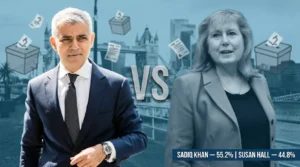
Susan Hall was the clear second-place candidate, but she finished around 11 percentage points behind Khan.
Her campaign performed strongly in several outer-London areas, particularly Bexley and Bromley, where Hall received 111,216 votes compared with Khan’s 48,952. She also led in Havering and Redbridge, Croydon and Sutton, Brent and Harrow, and narrowly in Ealing and Hillingdon.
Khan’s advantage was that his margins in some of the areas he won were much larger.
In North East, covering Hackney, Islington and Waltham Forest, Khan received 127,455 votes against Hall’s 34,099. In Lambeth and Southwark, he received 106,861 against Hall’s 26,347.
Consequently, strong Conservative results in outer London were not large enough to offset Labour’s advantage elsewhere.
The presence of Liberal Democrat, Green and Reform candidates also meant Londoners had several alternatives to the two largest parties. FPTP made that fragmentation politically important because those votes could not later transfer.
But “the opposition split its vote” is still only part of the explanation. Khan’s own 43.8% share was almost four percentage points higher than his first-preference share in 2021, while the Conservative share fell from 35.3% in 2021 to 32.7% in 2024.
If Khan Is Unpopular, Why Is He Still Mayor?
Because an opinion poll and an election answer different questions.
A politician does not leave office simply because an approval rating drops below 50%. Khan won the scheduled 2024 election and remains Mayor for the resulting term.
The August 2026 YouGov research illustrates this distinction particularly well.
YouGov found that 42% of Londoners said Khan was currently doing well as Mayor, while 47% said he was doing badly.
His overall favourability stood at 39% favourable and 48% unfavourable, giving him a net rating of -9. Interestingly, that was almost unchanged from his net rating of -8 shortly before the 2024 election that he subsequently won.
Views were also sharply different between inner and outer London.
| Area | Khan doing well | Khan doing badly |
| Inner London | 52% | 39% |
| Outer London | 37% | 51% |
| London overall | 42% | 47% |
The polling therefore broadly reflects the geographical differences visible in the 2024 election result.
What Do Londoners Think About Khan’s Record in 2026?
The same YouGov research shows why the political picture is more complicated than simply calling Khan popular or unpopular.
Transport remains his strongest of the Mayor’s main policy areas: 48% said he was handling transport well and 43% badly.
Crime produced a much more negative assessment, with 31% saying he was handling it well and 57% badly.
Housing was weaker still. Only 17% said Khan was handling housing well, compared with 66% who said badly.
There is also an important difference between perception and individual datasets. City Hall has pointed to falls in several crime categories, including violence with injury, homicide, burglary and lethal-barrel-discharge gun crime over selected periods.
Yet the YouGov findings show many Londoners remain dissatisfied with the Mayor’s handling of crime.
That distinction matters. Crime statistics, fear of crime, personal experience and public judgement of the Mayor are related, but they are not identical measures.
Which Controversies Have Followed Khan as Mayor?
Khan’s decade at City Hall has included several sustained political disputes. None prevented his re-election in 2024, although some continue to shape attitudes towards him.
| Period | Issue | Why it mattered |
| 2017–2026 | Donald Trump feud | Khan and Donald Trump have repeatedly criticised each other over terrorism, immigration, crime and London’s direction. The public dispute has continued into Trump’s current presidency. |
| 2019 | ULEZ introduced | The original ULEZ framework had been approved under Boris Johnson in 2015. Khan brought the start forward and launched the central London ULEZ on 8 April 2019. |
| 2023 | London-wide ULEZ expansion | The expansion generated particularly strong opposition in some outer-London areas. Several councils challenged the decision in court, but the High Court dismissed the challenge on all three grounds in July 2023 and the expansion proceeded on 29 August. |
| 2025–26 | Affordable housing targets | The London Assembly’s 2026 Affordable Housing Monitor recorded 14,335 starts under the 2021–26 programme by March 2026 against a revised target of 17,800–19,000. The target itself had previously been reduced from higher levels. |
| 2025–26 | Grooming-gang and child sexual exploitation scrutiny | The Met began reviewing roughly 9,000 historic group-based child sexual exploitation and abuse cases. London was subsequently selected as an area for the national grooming-gangs inquiry, while the London Assembly also launched scrutiny of the Met, MOPAC and mayoral oversight. Importantly, the 9,000 figure should not be described as 9,000 confirmed grooming-gang cases; the category includes a broader range of historic abuse cases requiring review. |
| 2026 | Growing demand for political change | YouGov found 56% thought Khan should allow another Labour candidate to contest the 2028 election. |
These disputes help explain why the question “why is Sadiq Khan still Mayor of London?” appears so frequently.
A voter may strongly oppose ULEZ, believe housing performance is poor or be dissatisfied with crime. But the Mayor is elected by the whole of Greater London.
Individual controversies only remove an incumbent electorally if enough voters ultimately choose another candidate.
In 2024, they did not.
Has Khan Missed London’s Housing Targets?
Housing is now one of the clearest areas of political pressure.
According to the London Assembly’s Affordable Housing Monitor 2026, the Affordable Homes Programme 2021–26 had delivered 14,335 affordable housing starts by March 2026, against a revised target of between 17,800 and 19,000.
That target had originally been 35,000, was renegotiated to between 23,900 and 27,200, and was subsequently reduced again. The March 2026 deadline was later allowed to be extended by up to six months on a case-by-case basis.
This helps explain why housing performs so poorly in Khan’s current polling.
It should nevertheless be separated from the question of whether he remains legally entitled to serve as Mayor. Poor ratings on a particular policy area do not terminate an elected mayoral term.
How Does Khan Compare With Previous London Mayors?
Since the modern Mayor of London position was created, London has had three elected mayors.
| Mayor | Period in office | Election wins | Prominent policies/issues |
| Ken Livingstone | 2000–2008 | 2 | Congestion Charge, transport policy |
| Boris Johnson | 2008–2016 | 2 | Cycle hire, 2012 Olympics, original ULEZ framework |
| Sadiq Khan | 2016–present | 3 | Hopper fare, ULEZ implementation and expansion, transport fares, policing, housing |
City Hall records Livingstone as serving from July 2000 to May 2008 and Johnson from May 2008 to May 2016. Khan has therefore already served longer than either predecessor.
Khan’s transport record also illustrates how policies can span administrations. Boris Johnson approved the original central-London ULEZ scheme in March 2015.
Khan subsequently brought its starting date forward, launched it in 2019 and later expanded it. Khan also introduced the one-hour Hopper bus and tram fare in September 2016.
There is no clean, like-for-like public approval series covering Livingstone, Johnson and Khan at identical points in their mayoralties, so assigning them directly comparable “approval scores” would be misleading.
A more useful contemporary comparison comes from YouGov’s August 2026 survey: 42% of Londoners said Khan had done a better job than Boris Johnson, 31% said worse and 17% said about the same.
Do Most Londoners Want Sadiq Khan to Step Down?
The wording of the latest poll needs to be understood carefully.
YouGov found that 56% of Londoners thought Khan should step down and allow another Labour candidate to contest the next mayoral election, while only 24% thought he should seek another term. Around 31% of people who voted for Khan in 2024 also thought somebody else should be Labour’s next candidate.
This does not mean 56% were demanding that Khan resign immediately from the mayoralty.
The question concerned whether he should stand again at the 2028 election.
That distinction is important when interpreting headlines saying Londoners want Khan to “step down”.
Will Sadiq Khan Run for a Fourth Term?
As of 9 September 2026, Khan has not formally confirmed that he will run again.
He said in June 2026 that he expected to make the decision in 2027, describing the third year of the mayoral cycle as the point at which he would normally decide. Reports have nevertheless suggested that preparations for a potential campaign are taking place.
The polling sends mixed signals. The August YouGov poll shows significant appetite for a different Labour candidate.
Yet a Savanta poll for Queen Mary University’s Mile End Institute published in July put Labour on 33%, with the Conservatives and Reform UK each on 18%, the Greens on 17% and Liberal Democrats on 9% in a hypothetical mayoral contest. Researchers said Labour would remain ahead after second preferences.
So Khan can simultaneously have significant negative personal ratings and remain electorally competitive.
His July 2026 appointment to the House of Lords also did not end his mayoral tenure. Reports at the time made clear that he would continue serving as Mayor of London.
Who Could Challenge Khan in 2028?
The next contest is already beginning to take shape.
Former Home Secretary James Cleverly has entered the race for the Conservative nomination, with former police and crime commissioner Festus Akinbusoye also seeking to become the Tory candidate.
Laila Cunningham, a former prosecutor, has been selected by Reform UK.
If Khan chooses not to run, Labour figures including Dawn Butler have been linked with the candidacy. Other parties will finalise their candidates closer to the election.
The restoration of Supplementary Vote could significantly affect campaign strategy because candidates once again have an incentive to appeal beyond their own first-choice supporters and compete for second preferences.
When Is the Next London Mayoral Election?
The next scheduled Mayor of London and London Assembly election will take place on Thursday 4 May 2028.
Unlike 2024, the mayoral contest will use the restored Supplementary Vote system, allowing voters to indicate a second preference.
Unless the law changes before then, there is nothing in London’s mayoral term-limit rules that prevents Khan from standing for a fourth term.
Whether Labour selects him and whether London elects him are separate questions.
Frequently Asked Questions
Why is Sadiq Khan still Mayor of London?
Sadiq Khan is still Mayor because there is no statutory term limit for the office and he won the May 2024 mayoral election, giving him a third term.
Is there a term limit for the Mayor of London?
No. A Mayor of London can seek re-election for further terms. Proposals for term limits have previously been discussed in Parliament but were not adopted.
How many times can someone be Mayor of London?
There is currently no statutory maximum number of terms. A mayor can continue standing in future elections provided they meet the relevant candidacy requirements.
Did Sadiq Khan win a third term?
Yes. Khan won his third mayoral election in May 2024 with 1,088,225 votes, compared with Susan Hall’s 812,397.
Who did Sadiq Khan beat in 2024?
His principal opponent was Conservative candidate Susan Hall. Liberal Democrat Rob Blackie and Green candidate Zoë Garbett each received about 5.8%, while Reform UK’s Howard Cox received about 3.2%.
Did Sadiq Khan win every London borough?
No. More importantly, official mayoral results are not published as 32 separate borough results. Votes are reported through London’s 14 GLA constituencies. Khan led in nine of them and Hall led in five.
Did First Past the Post help Khan win?
FPTP meant second preferences were not redistributed, so a candidate could win without securing 50%. That may have influenced campaign dynamics, but it cannot be proven that the system itself caused Khan’s victory. He led Susan Hall by more than 275,000 votes.
What voting system will London use in 2028?
Supplementary Vote has been restored for the 2028 London mayoral election. Voters will again be able to express a second preference.
When is the next London mayoral election?
The next scheduled election is 4 May 2028.
Will Sadiq Khan run again in 2028?
He has not formally confirmed a fourth-term campaign as of 9 September 2026. Khan has said he expects to announce his decision in 2027.


1 comment