





A Clitheroe landlord has been ordered to pay more than £5,600 after pleading guilty to failing to comply with an improvement notice issued over serious problems at a rented property.
Wajid Mahmood, 41, of Holden Street, Clitheroe, pleaded guilty in a prosecution brought by Ribble Valley Borough Council. Blackburn magistrates imposed a £2,025 fine, while the council said the overall amount payable came to £5,601.54.
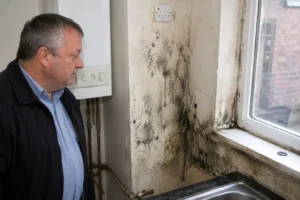
The case centred on a property in Bawdlands, Clitheroe, where council officers found problems including significant damp and mould, faulty electrics, a defective boiler and no hot running water.
Why Was Wajid Mahmood Fined?
 Mahmood was prosecuted because remedial work required by a council improvement notice was not completed within the required process.
According to Ribble Valley Borough Council, the case began after a tenant in a ground-floor flat reported that the front door would not lock and the shower was not working properly, with only cold water available.
Further complaints led environmental health officers to inspect the property. They reported several serious hazards, including damp and mould growth, electrical problems, a defective boiler and the absence of hot running water.
The council then served an improvement notice requiring the property owners to carry out remedial work.
Problems did not end there. After another tenant moved into the property, the council received further complaints. A subsequent inspection found that the majority of the repairs specified in the improvement notice had still not been completed, according to the authority.
Ribble Valley Borough Council said magistrates were also told that the condition of the property and the prolonged attempts to have the problems resolved had affected a tenant’s wellbeing. The tenant was reportedly unable to wash properly because there was no hot running water.
What Does an Improvement Notice Mean for a Landlord?
An improvement notice is a formal enforcement measure that a local authority can use where hazards in rented housing present a serious risk to occupants.
Ribble Valley Borough Council’s housing guidance says such a notice identifies the problem, specifies the repairs or improvements required and sets out when the work should begin and be completed.
Government guidance identifies failure to comply with an improvement notice as an offence under section 30(1) of the Housing Act 2004.
That distinction is important in the Wajid Mahmood landlord fine case: the prosecution was not simply the result of a tenant making a complaint. It followed the council issuing a formal notice and later finding that the required work had largely not been carried out.
Was Wajid Mahmood Fined Exactly £5,600?
The council’s published figures require some clarification.
Ribble Valley Borough Council states that Blackburn magistrates fined Mahmood £2,025 and ordered him to pay £2,846.54 in costs, while reporting an overall total of £5,601.54.
The two individually stated figures add up to £4,871.54. The council’s published news release does not separately identify the additional £730 included in its stated £5,601.54 total.
Therefore, describing the outcome simply as a “£5,600 fine” is less precise than saying Mahmood was fined £2,025 and, according to the council, ordered to pay £5,601.54 overall.
What Did Mahmood Say in Mitigation?
 The court was told that Mahmood pleaded guilty at the first opportunity and accepted that mistakes had been made.
In mitigation, it was said that a close family member had experienced serious health problems requiring his time and attention. Mahmood also accepted that work had been carried out later than it should have been, although most of the required work had subsequently been completed.
The Bawdlands property was jointly owned by Mahmood and another man. Both had initially been charged, but the council said it withdrew the charge against the second owner following Mahmood’s guilty plea because continuing the case against that person was not considered to be in the public interest.
Councillor Mark Hindle, chairman of Ribble Valley Borough Council’s health and housing committee, said rented properties should be “safe, clean and secure” and indicated that the authority would take enforcement action where landlords failed to meet required standards.
For landlords across England, the case highlights the difference between an initial request for repairs and a formal improvement notice. Once an improvement notice has been served, failing to carry out the required remedial work can become a housing offence rather than simply an unresolved maintenance dispute.