



Table of Contents Show
Elon Musk believes artificial intelligence and robotics could eventually make paid work optional and reduce the importance of money.
His argument is based on a simple idea: money is useful because people use it to obtain scarce goods, services and human labour. If intelligent machines can produce almost everything people need at extremely low cost, money may no longer play the same role.
The phrase “Elon Musk 2036 money prediction” has become a useful shorthand for this scenario. However, 2036 should not be treated as a guaranteed deadline. In his wide-ranging interview with Indian entrepreneur Nikhil Kamath, Musk predicted that work could become optional within 10 to 20 years, while describing the disappearance of money as a longer-term possibility.
That distinction matters. Musk is describing one possible technological future not announcing a policy, issuing a reliable financial forecast or advising people to stop saving.
What is Elon Musk’s 2036 Money Prediction?
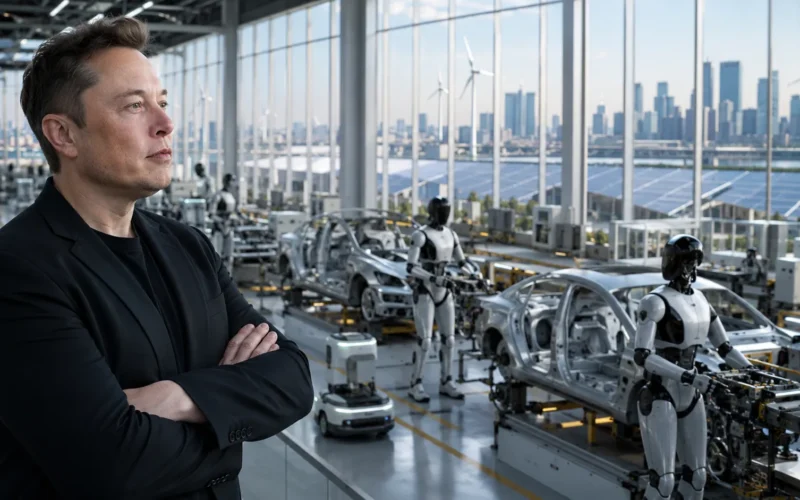
 Elon Musk predicts that rapid advances in AI and robotics could create a world in which machines produce enough goods and services to satisfy almost every human need.
In that scenario:
- People may no longer need traditional jobs to survive.
- AI and robots could produce goods at extremely low cost.
- Society could move towards a “universal high income”.
- Prices could fall if production grows faster than the money supply.
- Money could become less relevant because human labour would no longer be the main economic constraint.
Musk has not proved that this will happen by 2036. His prediction depends on major advances in robotics, energy, manufacturing, AI safety and wealth distribution.
What Did Elon Musk Actually Say About Money?
In a wide-ranging conversation with Indian entrepreneur Nikhil Kamath, Musk described money as “an information system for labour allocation”. He argued that money does not have practical value on its own; its usefulness comes from allowing people to access labour, products and services.
To illustrate the point, Musk imagined someone stranded alone on a desert island with a trillion dollars. Despite possessing enormous financial wealth, the person would have nobody to employ and nowhere to spend the money.
Asked how money might change in the future, Musk said: “I think long term, money disappears as a concept.”
He explained that money could become far less important if AI and robots were eventually able to meet human needs without depending on conventional paid employment.
This is the foundation of the Elon Musk 2036 money prediction. It is not primarily a claim about cash becoming illegal or bank accounts suddenly closing. It is a claim about money becoming less necessary because production would no longer depend heavily on paid human labour.
Readers can hear the wider discussion in Musk’s appearance on Nikhil Kamath’s People by WTF podcast.
Why Does Musk Think Work Could Become Optional?
Musk believes advances in artificial intelligence and humanoid robotics will eventually allow machines to perform almost every task currently completed by humans.
During the interview, he predicted that:
“Working at all will be optional like a hobby pretty much.”
He compared future work with growing vegetables at home. Most people can buy vegetables more easily than they can grow them, but some still choose gardening because they enjoy it. Musk believes employment could eventually work in a similar way: people might continue working for purpose, status, creativity or personal satisfaction rather than financial survival.
He suggested that this transition could happen within fewer than 20 years and perhaps within 10 to 15 years.
That range helps explain the 2036 headline. A ten-year prediction made in the mid-2020s points towards the mid-2030s, but Musk did not establish a precise date on which employment or money would suddenly disappear.
What is Universal High Income?
 Musk has spoken about universal high income, or UHI, rather than only universal basic income.
Universal basic income usually refers to a regular payment intended to cover essential living costs. Universal high income describes a much more ambitious future in which automated production creates such extensive wealth that people can obtain more than a basic standard of living.
Musk’s reasoning is that AI and robots could increase productivity so dramatically that essential goods and services become widely available.
In the interview, he said:
“If you can think of it, you can have it.”
This would represent a post-scarcity economy: a system in which traditional shortages become far less important because automated production can meet demand.
However, Musk did not explain exactly how universal high income would be funded, distributed or administered. There is also no confirmed UK government plan to introduce UHI.
The idea therefore remains a speculative economic outcome rather than an existing policy.
How Could AI Make Goods and Services Cheaper?
Prices are influenced by many factors, but one important factor is the relationship between supply and demand.
If AI systems and robots can produce more food, vehicles, buildings, software, transport and professional services, the supply of those goods and services could increase. If production rises faster than demand, prices may fall.
Musk argued that large-scale automation could produce deflation if the output of real goods and services grows more quickly than the money supply.
He said AI had not yet raised productivity enough to create this effect across the wider economy. However, he predicted that goods-and-services growth could begin exceeding money-supply growth within approximately three years.
That should be treated as Musk’s forecast, not an established economic consensus.
Inflation is more complicated than one ratio alone. Energy prices, wages, interest rates, supply chains, taxation, consumer demand, exchange rates and government spending can all influence the cost of living.
For UK readers, the Bank of England’s explanation of inflation provides a broader account of why prices rise and how inflation is measured.
Could Energy Replace Money?
Musk also argued that energy is a more fundamental form of economic value than money.
He told Kamath:
“Energy is the real … true currency.”
His reasoning is that governments can create additional money, but they cannot produce useful energy merely by changing a law or altering a financial database. Electricity and fuel require infrastructure, physical resources and productive capacity.
Musk connected this idea to the Kardashev scale, which measures the theoretical development of a civilisation according to how much energy it can use.
Under this view, a highly advanced economy might be judged by how effectively it converts energy into useful activity rather than by how much conventional money it creates.
However, energy would not automatically function as household money. People would still need a practical way to exchange goods, compare value and store purchasing power.
The Bank of England explains that money currently performs three central functions: it acts as a medium of exchange, a store of value and a common system for measuring prices.
Unless AI removes almost every form of scarcity, some type of money, credit or allocation system would probably remain necessary.
Would Everything Really Become Abundant?
 Musk’s prediction depends on the idea that AI and robots could eventually satisfy almost every human need.
That may be easier for some products than others.
Digital products such as software, entertainment, educational material and certain professional services can often be reproduced at very low additional cost. Physical goods remain more difficult because they require energy, materials, transport, land and infrastructure.
Even in a highly automated economy, several things may remain scarce:
| Potentially Abundant | Likely to Remain Scarce |
|---|---|
| AI-generated digital content | Desirable land and housing |
| Automated customer support | Rare minerals and raw materials |
| Standard software services | Electricity-grid capacity |
| Mass-produced household goods | Advanced computer chips |
| Routine administrative work | Human attention and trust |
| Some transport services | Unique experiences and live events |
Musk himself recognised this distinction when discussing live events. He suggested that physical experiences could become more valuable as digital media becomes increasingly abundant.
In other words, AI may reduce scarcity in certain markets while increasing the premium attached to things that cannot be copied easily.
What Could Happen to Jobs in the UK?
The UK labour market is already being affected by artificial intelligence, although the evidence does not support the conclusion that paid employment will disappear within ten years.
Research published through the London Datastore estimated that at least 46% of London workers approximately 2.4 million people were employed in occupations where generative AI could automate some tasks. The comparable estimate across the UK was 38%.
Exposure does not mean that all those jobs will disappear.
A job may contain several different tasks. AI might automate routine reporting, data analysis or document preparation while leaving human workers responsible for judgement, communication, accountability and client relationships.
A separate UK government assessment of AI and the labour market found that vacancies had declined more sharply in occupations considered highly exposed to AI between 2022 and 2025.
However, the report did not establish that AI caused the decline. Recruitment was also affected by interest rates, weak economic conditions and pressures within individual industries.
Government projections published in the report on AI skills for life and work suggest that millions of UK workers could be involved in AI-related activities by 2035.
This points towards widespread job transformation, not necessarily the complete end of employment.
Which UK Jobs Could Change First?
Roles involving repetitive information processing are likely to experience some of the earliest changes.
These may include:
- Administrative support
- Entry-level financial analysis
- Customer-service operations
- Document preparation
- Basic coding and software testing
- Marketing production
- Legal research
- Data entry
- Routine translation
- Scheduling and reporting
Jobs involving physical work could also change as robotics improves. However, building reliable robots that can operate safely in unpredictable homes, hospitals, factories and public spaces is a difficult engineering problem.
Tesla’s work on Optimus humanoid robots illustrates both the ambition and the technical challenges. A robot that performs a controlled factory task is very different from one that can complete any job a human can do.
A Realistic Example of the Transition
Consider a fictional London accountancy firm employing 100 people.
The company introduces AI systems capable of preparing basic reports, identifying inconsistencies and drafting routine client communications.
The technology does not immediately eliminate all 100 jobs. Instead:
- Junior employees spend less time entering and checking data.
- Accountants review AI-generated work rather than creating every document manually.
- Managers focus more on client advice and complex decisions.
- The company needs fewer workers for certain repetitive tasks.
- New roles emerge in AI supervision, compliance and data governance.
- Employees require additional training.
The company may become more productive, but the benefits do not automatically reach every worker.
Owners could keep most of the additional profit, customers could receive lower prices, employees could work fewer hours, or the company could expand and hire more people. The outcome depends on competition, regulation, ownership and business decisions.
This is why AI abundance does not automatically create universal prosperity.
Who Would Own the AI Economy?
 Ownership is one of the biggest unanswered questions in Musk’s prediction.
If a small number of businesses own the most productive AI systems, robots, data centres, factories and energy infrastructure, economic inequality could increase even as total production rises.
A society can produce more wealth without distributing it equally.
For universal high income to become possible, governments and businesses would need to address questions such as:
- Who owns productive AI systems?
- How should automated profits be taxed?
- Would citizens receive direct payments?
- How would pensions work if employment declined?
- Who would pay for healthcare and public services?
- Would people receive income, services or ownership shares?
- How would access to scarce housing and land be decided?
Musk’s interview does not provide a detailed policy framework for answering these questions.
Does Musk Think This Future is Guaranteed?
No.
One of the most important E-E-A-T details in the interview is Musk’s acknowledgement that his forecast could be wrong.
When discussing optional work, he said people might replay the interview in 20 years and describe the prediction as ridiculous if it failed to materialise. He also distinguished between what he expected to happen and what he personally wanted to happen.
“These are just what I think will happen based on what I see,” he said.
He described the coming period as a technological singularity an event horizon beyond which outcomes become difficult to predict.
Musk has also repeatedly acknowledged that powerful AI could create serious risks. In the Kamath interview, he argued that AI systems should value truth, beauty and curiosity, warning that forcing an AI to accept false information could lead to dangerous conclusions.
The wider prediction therefore contains both optimism and uncertainty.
Should UK Households Change Their Financial Plans?
Musk’s prediction should not be used as a reason to abandon savings, pensions or responsible financial planning.
There is no verified evidence that:
- The pound will disappear by 2036.
- UK salaries will become unnecessary.
- Universal high income will be introduced.
- Housing, food and energy will become free.
- Pensions will no longer matter.
- Every job will be automated.
People should continue making financial decisions based on current circumstances, personal goals and established guidance rather than an uncertain technological forecast.
Musk’s comments are more useful as a prompt for thinking about long-term economic change than as a practical personal-finance instruction.
Key Takeaways
The Elon Musk 2036 money prediction is based on the possibility that AI and robotics could make human labour less economically necessary.
Musk believes work may eventually become optional, while universal high income and automated production could give people access to far more goods and services.
He has also suggested that money may lose its relevance if machines can satisfy human needs without conventional labour.
However, the prediction depends on breakthroughs that have not yet happened at the required scale. Scarcity, ownership, regulation, inequality and resource constraints could all prevent a fully post-scarcity economy from emerging.
The most important question may not be whether money disappears. It may be whether the wealth created by AI is shared widely enough for money to matter less to ordinary people.
Conclusion
Elon Musk’s vision of 2036 is an optimistic but uncertain picture of a world transformed by artificial intelligence.
In that world, machines perform most jobs, production becomes abundant, prices fall and people work because they choose to—not because they need an income.
His own words make clear that the prediction is not a promise. It is an extrapolation based on the rapid development of AI, robotics and energy systems.
For the UK, the near-term reality is likely to be more gradual. Jobs will change, businesses will automate tasks and demand for AI skills will grow. Money, wages, pensions and financial planning will continue to matter while essential goods and resources remain scarce.
Whether Musk’s post-money economy arrives will depend not only on what AI can produce, but also on who owns it, who benefits from it and how societies distribute the resulting wealth.
Frequently Asked Questions
Did Elon Musk Say Money Will Disappear in 2036?
Musk has predicted that money could eventually disappear as a concept and that work could become optional within approximately 10 to 20 years. The year 2036 is best treated as a headline interpretation of that timeframe, not a fixed deadline.
Why Does Elon Musk Think Money Will Become Irrelevant?
He views money as a system for allocating labour. If AI and robots can produce everything people need without depending on human work, he believes money’s role could decline.
What is Universal High Income?
Universal high income is Musk’s idea that AI-driven productivity could provide people with more than a basic level of financial support. It is not currently an official UK policy.
Will AI Make All Products Free?
AI may reduce the price of some products and services, but housing, land, energy, minerals, infrastructure and other scarce resources are unlikely to become unlimited automatically.
Could AI Cause Deflation?
AI could contribute to lower prices if it increases the supply of goods and services faster than demand and the money supply. However, inflation and deflation are influenced by many additional economic factors.
Will People Still Have Jobs in 2036?
Most evidence suggests that many jobs will change significantly. Some tasks and roles may disappear, while new ones could be created. There is not enough evidence to conclude that employment will become universally optional by 2036.
Should People Stop Saving Because Money May Disappear?
No. Musk’s comments are speculative predictions. UK households should continue making savings and pension decisions based on current financial conditions and reliable professional guidance.
Could Energy Become the New Currency?
Musk believes energy is a fundamental measure of productive capacity. However, an economy would still need a practical mechanism for exchanging goods, recording value and allocating scarce resources.
What is the Biggest Problem With Musk’s Prediction?
The largest unresolved issue is distribution. Even if AI creates extraordinary wealth, money may remain essential unless ordinary people can access the goods, services and resources produced.