




Table of Contents Show
Snapshot
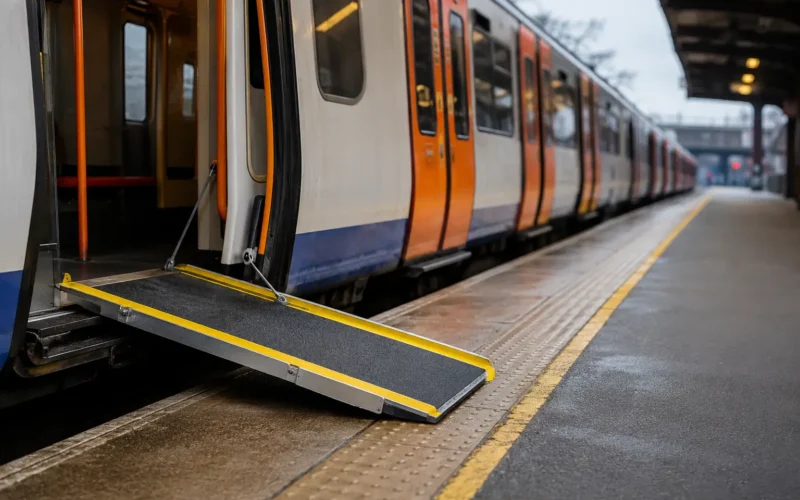
The London Overground ramp safety report has revealed how a train left Norwood Junction station with a portable access ramp still attached on 1 July 2025. The Rail Accident Investigation Branch (RAIB) found that the wrong type of ramp, ineffective dispatch checks, driver distraction linked to a mobile phone call, and a cropped in-cab monitor view all contributed to the serious near-miss. No injuries were reported, but the incident exposed wider safety concerns around accessibility equipment, driver attention, and station equipment checks.
According to the RAIB London Overground ramp safety report, the incident occurred when a London Overground train departed Platform 1 at Norwood Junction with a boarding ramp still trapped in a doorway. Although the ramp was dragged approximately 160 metres before striking an end-of-platform barrier, nobody was injured.
While some headlines focused on the driver’s phone call, the investigation revealed a more complex story. The report identified equipment-management issues, visibility limitations, dispatch procedure failures and organisational weaknesses that together created the circumstances for a dangerous occurrence.
The findings are significant because they demonstrate how multiple safety systems can fail simultaneously, even during what should be a routine assisted boarding operation.
Source: RAIB Report 09/2026
What Does the London Overground Ramp Safety Report Actually Say?
 In simple terms, the report concludes that the train departed because several safety barriers failed at the same time.
RAIB identified four major contributing factors:
- The wrong type of portable access ramp was used.
- The train doors were able to close over the ramp.
- The driver’s dispatch checks were ineffective and were probably affected by a mobile phone conversation.
- Platform staff warning signals could not be seen because of the way the in-cab monitor image was displayed.
The investigation did not focus on assigning blame. Instead, it examined why the existing safeguards failed and how future incidents can be prevented.
This distinction is important.
Modern rail safety investigations seek to understand how systems, procedures, equipment and human behaviour interact, rather than simply identifying a single individual error.
What Happened at Norwood Junction on 1 July 2025?
The incident involved London Overground service 9D18 travelling from West Croydon to Highbury & Islington.
When the train arrived at Norwood Junction station, staff deployed a portable boarding ramp to assist a passenger using a mobility scooter.
The passenger boarded successfully.
However, after boarding was completed, the ramp remained trapped in the train doorway.
The train then departed with the ramp still attached.
As the service accelerated away from the platform, the ramp travelled alongside the carriage before colliding with an end-of-platform barrier and becoming detached.
RAIB said the ramp collided with the barrier and fell beside the track. No injuries were reported, although a member of station staff and a passenger had to move clear of the ramp. (Source placement: RAIB incident findings)
Although the outcome could have been far worse, the incident highlighted significant weaknesses in operational controls and safety procedures.
What Did RAIB Find?
The investigation identified a combination of equipment, operational and human factors.
The Wrong Ramp Was Used
One of the report’s most significant findings was that the ramp used was not the approved type for the train involved.
According to the study, the station had reportedly been without the proper ramp since September 2021.
This indicated that employees were operating machinery that lacked the design features required to stop train doors from completely closing in the event that a ramp became stuck.
The investigation found that the ramp was the incorrect type for the train, meaning the train doors could close and traction power could still be taken even with the ramp attached. (Source placement: RAIB investigation report)
Driver Distraction Was Identified as a Contributing Factor
The report found that the driver’s dispatch checks were ineffective.
RAIB stated that this was probably because the driver was distracted while making a personal mobile phone call at the time of departure. Importantly, the report does not present the phone call as the sole cause. Rather, it identifies the distraction as one factor within a wider chain of failures.
According to RAIB, the driver was likely distracted while making a cell phone call at the time of departure, which is why the driver’s dispatch checks were ineffective.(Source placement: RAIB investigation report)
Platform Warnings Were Not Visible
When platform staff realised the ramp remained trapped, they attempted to stop the train using emergency hand signals.
Nevertheless, those signals were not visible on the driver’s screen due to the cropping of the in-cab monitor image.
This meant an important final safety intervention failed.
Why Was the Wrong Ramp Still Being Used?
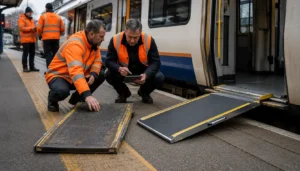 Arguably, one of the most concerning findings was not the mobile phone call but the apparent long-term equipment issue.
According to the study, the appropriate ramp hasn’t been accessible since September 2021. This raises important questions about equipment auditing and asset management processes. Most people think of portable boarding ramps as accessibility tools.
However, the Norwood Junction incident demonstrates that they also perform an important safety function. If the wrong ramp can allow train doors to close and lock incorrectly, then ramp management becomes a safety-critical activity. The wider lesson is that seemingly minor equipment discrepancies can have significant operational consequences.
Why Didn’t the Driver See the Warnings?
Public discussion often assumes that platform staff can simply signal a train driver if a problem occurs.
However, this incident demonstrates that warnings are only effective if they are visible. The driver’s monitor displayed CCTV images intended to support dispatch procedures.
Unfortunately, the image shown in the cab did not include the full platform area. As a result, staff members attempting to stop the train were outside the visible frame.
This finding highlights a broader challenge facing modern transport systems. Technology can improve safety, but only when information is presented in a way that supports effective decision-making. A system that unintentionally hides critical information can create risks that remain unnoticed until an incident occurs.
How Driver Distraction Contributed to the Near-Miss?
Research across multiple industries consistently shows that active mobile phone conversations can reduce situational awareness. Unlike listening to background audio, a two-way conversation requires continuous mental processing.
In safety-critical environments, this can narrow attention and reduce the ability to identify unexpected hazards.
Cognitive Tunnelling
Safety specialists often describe this phenomenon as cognitive tunnelling. This occurs when an individual’s attention becomes focused on one task while important surrounding information is overlooked.
In this case, investigators concluded that the driver looked at the relevant systems but did not effectively identify the abnormal situation.
Confirmation Bias
Another important factor is confirmation bias. The train’s systems indicated that the doors were correctly secured.
Because the incorrect ramp allowed the doors to close fully, the train appeared ready to depart. When people receive information that confirms their expectations, they may become less likely to search for contradictory evidence. This appears to have played a role in the incident.
Was This a Driver Error or a Wider System Failure?
 The simplest explanation is that a distracted driver departed while a ramp remained attached.
However, the investigation points towards a wider systems failure. Multiple safeguards were intended to prevent precisely this type of event. Several of them failed.
Viewed individually, none of these failures guaranteed a dangerous occurrence. Combined, they created a pathway towards risk.
This is why the report should be viewed as a broader railway safety story rather than simply a driver distraction story.
What Does the Incident Reveal About Accessibility Procedures?
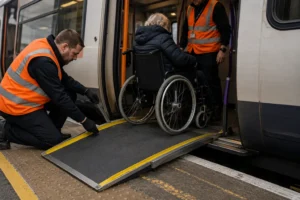
The incident highlights the importance of balancing accessibility and operational safety. Portable boarding ramps remain essential for many passengers with reduced mobility. Every day, railway staff across the UK use ramps safely to assist passengers. The report does not suggest that boarding assistance is inherently unsafe.
Instead, it demonstrates the importance of:
- Correct equipment selection
- Staff training
- Effective communication
- Compatibility checks
- Regular equipment audits
Accessibility and safety should not be viewed as competing priorities.
Both objectives must be achieved simultaneously.
Could Similar Incidents Happen Elsewhere?
One reason safety investigations matter is that they help identify wider risks. The themes identified at Norwood Junction are not unique. Across transport industries, investigations frequently identify:
- Human distraction
- Equipment compatibility issues
- Communication failures
- Over-reliance on automation
- Organisational oversight gaps
Finding these weaknesses before someone is gravely hurt is what makes near-miss investigations valuable. For that reason, the Norwood Junction event should be viewed as a learning opportunity for the wider rail sector.
What Changes Did RAIB Recommend?
The report resulted in six recommendations aimed at reducing future risks.
RAIB made six recommendations covering ramp management, legislation and regulation around portable access ramps, and the use of mobile devices by train drivers. (Source placement: RAIB safety recommendations)
The recommendations focus on:
- Improving management of portable access ramps
- Reviewing industry standards
- Strengthening safety oversight
- Examining mobile-device risks
- Improving communication procedures
- Enhancing regulatory guidance
The objective is not simply to address one incident but to reduce the likelihood of similar occurrences across the railway network.
Could Technology Help Prevent Similar Incidents?
While RAIB did not specifically recommend artificial intelligence systems in its report, the incident raises broader questions about how technology could support future railway safety improvements.
Possible developments include:
Smart Ramp Detection
Future ramps could communicate directly with train safety systems and prevent movement if a ramp remains attached.
Improved CCTV Visibility
Enhanced monitor layouts could help ensure that critical platform areas remain visible at all times.
Driver Attention Monitoring
Some transport sectors already use systems that identify distraction or reduced attention.
Enhanced Safety Analytics
Operators may increasingly use operational data to identify trends and emerging risks before incidents occur. These remain potential future developments rather than official recommendations arising from the investigation.
Conclusion
The London Overground ramp safety report reveals far more than a single operational mistake.
The investigation identified a combination of ramp compatibility issues, ineffective dispatch checks, driver distraction linked to a mobile phone call, limited monitor visibility and equipment-management weaknesses.
Together, these failures allowed a train to depart with a boarding ramp still attached. The most important lesson is probably that major incidents are rarely caused by a single factor.
Instead, they occur when multiple safety barriers fail simultaneously.
For the wider rail industry, the findings may influence future safety reviews relating to accessibility equipment, dispatch procedures, monitor visibility and mobile-device policies.
Most importantly, the incident demonstrates why near-miss investigations remain a vital part of improving railway safety across the UK.
FAQs
How long can a ramp be without a landing in the UK?
For general building-access ramps, UK guidance typically requires level landings at specified intervals depending on the ramp’s gradient and length. Requirements vary depending on the environment and intended use. Railway boarding ramps operate under separate accessibility and operational standards.
Is the Overground safe?
Yes. London Overground is generally considered a safe transport network and operates under strict railway safety regulations. Serious incidents are relatively uncommon, and investigations such as the Norwood Junction report help operators identify and address potential risks.
What is the safest railway in the world?
There is no official global ranking. However, train systems in nations like Singapore, Switzerland, and Japan are well known for their strict operational standards, cutting-edge technology, and solid safety records.
How many train fatalities per year in the UK?
The number varies each year. Most railway fatalities in the UK are linked to trespass, suicide or level crossing incidents rather than train accidents. Official figures are published annually by the Office of Rail and Road (ORR).
What is a portable access ramp on the railway?
A portable access ramp is a movable boarding aid used to help passengers with mobility needs safely board and leave trains where there is a gap between the train and platform.
Why are near-miss investigations important?
Investigations of near-misses assist in identifying hazards prior to major injuries. They allow safety improvements to be introduced without waiting for a major accident.
What is a train dispatch check?
A dispatch check is the process used by train drivers and station staff to ensure that doors are secure, passengers are safe and the platform is clear before a train departs.
Who investigates railway incidents in the UK?
The Rail Accident Investigation Branch (RAIB) is responsible for investigating railway accidents and dangerous occurrences across the UK with the aim of improving safety and preventing future incidents.