





Table of Contents Show
Updated: 13 October 2026
There are no official Ivy League schools in the UK. The Ivy League consists of eight American universities, including Harvard, Yale, Princeton and Columbia. However, Britain has several internationally recognised institutions, including the University of Oxford, University of Cambridge, Imperial College London and University College London (UCL).
The UK’s Russell Group, which comprises 24 research-intensive universities, is frequently compared with the American Ivy League. Nevertheless, these organisations serve different purposes, and Russell Group membership does not guarantee that a university is the best choice for every student.
For students preparing to enter university in 2027, choosing an institution involves more than academic reputation. Tuition fees, accommodation, admissions tests, scholarships and graduate outcomes can significantly affect the overall experience.
Our October 2026 research highlights an important financial consideration: average undergraduate accommodation at UCL could consume approximately 88.3% of the maximum standard London maintenance loan for an eligible student in 2026/27.
When we include UCL’s published estimates of other essential living expenses, the illustrative funding gap increases to approximately £2,331 over a 39-week academic accommodation period.
These calculations are based on published information rather than student interviews or a nationwide survey. They provide a practical example of why prospective students should compare university costs before making a final decision.
This guide examines ten prominent UK universities, explains important 2027 admissions changes and provides original financial comparisons to help students make better-informed choices.
What Is the UK’s Equivalent of the Ivy League?
The Russell Group is the closest commonly discussed UK comparison to America’s Ivy League, although the two organisations are not equivalent.
The American Ivy League is an athletic conference comprising eight universities. The Russell Group represents 24 research-intensive institutions and focuses on research, higher education and related policy matters.
Oxford and Cambridge are not Ivy League universities, despite sometimes being described informally as British equivalents.
The phrase UK Ivy League is therefore best understood as an informal comparison of prestigious universities rather than the name of an official British educational organisation.
Does the UK Have an Official Top 10 University Group?
No. Britain has several university rankings, research organisations and higher education associations, but there is no official UK Ivy League or nationally designated top-ten membership group.
Universities perform differently depending on the subject and measurement system.
A university might have a particularly strong reputation in engineering while another offers a course structure better suited to an individual student studying politics, medicine or business.
For this reason, our selection below is an editorial shortlist rather than a formal ranking.
What Are the Top 10 UK Universities Comparable to the Ivy League?
These ten universities are worth investigating because of their established academic and research profiles, broad recognition or specialist educational focus.
These subject suggestions are not individual subject rankings. Applicants should examine course requirements and current academic information.
1. University of Oxford
 Oxford is one of Britain’s oldest universities and is known for its collegiate structure and tutorial-based teaching.
Students belong to both a college and the wider university, with academic teaching provided through different arrangements depending on their subject.
The tutorial system encourages detailed discussion, independent preparation and close examination of academic questions.
Oxford may particularly appeal to students who enjoy developing arguments, reading extensively and studying their subject in considerable depth.
However, the university has demanding admissions requirements. Certain courses require additional assessments, interviews or written work.
What students should investigate: Course-specific entry requirements, admissions tests, teaching methods, accommodation and scholarships.
2. University of Cambridge
 Cambridge also operates a collegiate system and uses small-group supervision teaching as an important part of its academic approach.
It offers programmes across mathematics, engineering, natural sciences, humanities, medicine and other subjects.
Although Oxford and Cambridge share certain features, their courses are not identical.
For example, the structure and content of a science degree at Cambridge may differ significantly from a related course at Oxford.
Students should compare the actual curriculum rather than choosing between the two institutions purely by reputation.
What students should investigate: Course content, required A-level subjects, additional assessments, college arrangements and living expenses.
3. Imperial College London
 Imperial is particularly relevant to students considering science, technology, engineering, medicine and quantitative subjects.
Its specialist academic environment differs from that of universities offering a wider range of humanities and social science programmes.
Located in London, Imperial also provides students with proximity to research organisations, healthcare institutions and major employers.
However, studying in the capital can create additional financial pressures.
What students should investigate: Technical facilities, accreditation, placement opportunities, admissions assessments and London accommodation costs.
Students considering other specialist institutions can also explore our guide to business schools in London.
4. University College London
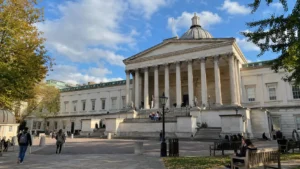 UCL offers a broad range of undergraduate and postgraduate programmes, including architecture, engineering, medicine, sciences and humanities.
Its location provides access to many of London’s cultural and academic institutions.
However, university accommodation can represent a considerable financial commitment.
Our examination of UCL’s published 2026/27 accommodation costs shows that different room types within the same university residence can vary by more than £2,600 over a 39-week contract.
What students should investigate: Accommodation prices, departmental teaching facilities, financial support and graduate outcomes.
5. London School of Economics and Political Science
 LSE focuses on social sciences and is particularly relevant to students interested in economics, political science, sociology, international relations and related disciplines.
Its specialist academic character makes direct comparison with a broad-based university more complicated.
A student interested in economics, for example, should investigate the mathematical content and optional modules of the course before applying.
What students should investigate: Subject requirements, mathematical preparation, course content, assessment methods and total living costs.
6. King’s College London
 King’s College London offers programmes across medicine, healthcare, law, humanities and social sciences.
Its teaching operates across different campuses in London.
Because campus locations differ, students should investigate the precise location of their department before arranging accommodation.
Daily transport costs can be an important part of the student budget.
What students should investigate: Campus location, professional accreditation where relevant, placements, accommodation and scholarships.
7. University of Edinburgh
 Edinburgh offers undergraduate degrees across a broad range of academic disciplines, including sciences, medicine, informatics and humanities.
Students should pay particular attention to Scotland’s university degree structure.
Many Scottish undergraduate honours degrees normally last four years, although certain programmes have different durations.
This can provide opportunities for broader academic study but may affect total living expenses.
What students should investigate: Degree length, course flexibility, tuition fee status, funding arrangements and accommodation.
8. University of Manchester
 Manchester is a large research-intensive university offering courses in engineering, sciences, business, humanities and healthcare.
Its major-city environment provides an alternative to studying in London.
However, students should avoid assuming that all university cities outside the capital are inexpensive.
Actual accommodation charges, transport needs and personal spending can vary considerably.
What students should investigate: Teaching facilities, placement years, individual course outcomes and total annual expenses.
9. University of Bristol
 Bristol offers academic programmes across engineering, sciences, medicine, humanities and social sciences.
It is worth investigating for students who want a research-intensive university in a major English city.
Applicants should compare the specific department and course rather than relying on general university reputation.
What students should investigate: Academic modules, entry requirements, practical teaching, accommodation and graduate destinations.
10. University of Warwick

Warwick offers programmes across mathematics, economics, business, sciences, humanities and other disciplines.
Its campus setting provides a different university experience from institutions spread across central London.
Students who prefer a concentrated campus environment may find this distinction important.
What students should investigate: Course flexibility, teaching approach, accommodation, work placements and transport arrangements.
Our Original Research: Where Are Russell Group Universities Located?
To investigate the geographical distribution of prestigious UK research universities, London Local News counted the 24 institutions listed as Russell Group members and grouped them by country.
The results show a significant concentration in England.
London Local News calculation, October 2026. Percentages are rounded.
How Many Russell Group Universities Are in London?
Five Russell Group universities are located in London: Imperial College London, King’s College London, London School of Economics and Political Science, Queen Mary University of London and UCL.
Our calculations show that London accounts for 20.8% of Russell Group membership.
London also accounts for four of the ten universities featured in our editorial shortlist.
That represents 40% of our selected institutions.
What Does This Tell Us?
London has a prominent position within UK research-intensive higher education, but it is not home to most Russell Group universities.
A student who investigates only London’s internationally famous institutions could overlook suitable courses elsewhere in Britain.
This does not suggest that a university outside London is automatically better or cheaper.
Rather, it highlights the importance of considering geographical alternatives.
For additional context, read our feature on why London remains attractive to international students.
How Much Are UK University Tuition Fees in 2026 and 2027?
University costs depend on the institution, course, study year and the student’s fee status.
For eligible full-time undergraduate programmes at qualifying English universities permitted to charge the higher regulated fee, the maximum annual tuition fees are:
These figures are published government fee limits. They are not necessarily the charges for every course or student.
Our Calculation: How Much Are Fees Increasing?
The increase from £9,790 to £10,050 represents an additional £260 per academic year.
That is an increase of approximately 2.66%.
For a hypothetical three-year course charging £10,050 annually throughout, the total tuition amount would be £30,150.
However, universities may adjust their fees in later years subject to applicable rules, so students should not assume that a published first-year fee will remain fixed.
International fees can be substantially higher, and different student funding arrangements apply across the four UK nations.
Original Investigation: Can a Student Maintenance Loan Cover University Accommodation?
Accommodation deserves particular attention because it is often one of the largest recurring student expenses.
For our research, we used UCL’s published 2026/27 accommodation costs alongside the government’s confirmed maintenance loan rates for England.
The maximum standard maintenance loan for an eligible student living away from home and studying in London in 2026/27 is £14,135, excluding students eligible for the higher benefits-related rate.
UCL publishes an average undergraduate self-catered hall rent of £320 per week over 39 weeks.
What Percentage of the Maximum Loan Goes Towards Rent?
Our finding: Rent alone would consume approximately 88.3% of the maximum standard maintenance loan in this example.
Only £1,655 of the loan would remain after accommodation across the 39-week period.
That money would still need to contribute towards food, travel, course materials and other expenses.
These figures do not describe every UCL student’s financial position. Individual loan entitlement, accommodation choice, family support, bursaries and other income can change the calculation.
What Happens If We Include Other Basic Living Expenses?
UCL also publishes indicative weekly estimates for food, study materials, mobile phone expenses, health and wellbeing, and a student travelcard.
Adding these estimated expenses to average accommodation produces a broader calculation.
Our Finding: Essential Costs Could Exceed the Maximum Loan by £2,331
The combined accommodation and essential-cost estimate is approximately 16.5% higher than the maximum standard loan in this example.
This is an important distinction from simply comparing rent against student funding.
However, UCL’s non-rent spending estimates are indicative rather than mandatory charges. Students may spend more or less in individual categories.
The calculation also excludes possible accommodation and living costs outside the 39-week period, discretionary spending and emergencies.
It should therefore be treated as a budgeting illustration, not a universal student funding deficit.
Students needing help understanding available support can read our guides to student finance in England and applying for student finance.
Our Room Price Comparison: Could Accommodation Choice Save £2,673?
We examined UCL’s published prices for two room types at John Adams Hall for the 2026/27 academic year.
Both have a 39-week accommodation contract, allowing a direct comparison of the published rent.
The single ensuite costs approximately 25.9% more than the standard single room.
How Does Room Choice Affect a Student’s Remaining Money?
Using the same maximum standard maintenance loan and UCL’s estimate of £3,985.80 for other essentials:
This comparison identifies a difference of approximately £2,673 in the funding gap solely from choosing a different room type.
Our insight: Students should compare individual room prices before assuming that all accommodation at the same university carries a similar cost.
The figures do not guarantee that a particular room will be offered. Availability, accessibility requirements and allocation arrangements can influence a student’s choices.
Is Oxford or Cambridge More Affordable in 2027?
Oxford and Cambridge publish estimates of living expenses for students planning their finances.
Their published 2027/28 guidance gives the following figures.
These estimates exclude tuition fees.
They should not be interpreted as a precise like-for-like price ranking.
Oxford presents a range, while Cambridge publishes an indicative monthly budget based on student spending information and projected prices.
What Can Students Learn From These Figures?
Oxford’s lower nine-month estimate is £1,305 greater than Cambridge’s indicative nine-month figure.
However, the estimates use different methods and assumptions.
The difference therefore does not establish that Cambridge will be cheaper for every student.
A more meaningful comparison would investigate accommodation availability, college arrangements, food costs, course materials and the number of months the student expects to live in the city.
Our assessment: Comparing universities through detailed spending categories is more reliable than comparing a single headline living-cost number.
What Scholarships Are Available at Prestigious UK Universities?
Scholarships and bursaries can substantially change the affordability of a university education.
Oxford’s Crankstart Scholarship provides a useful example of confirmed financial support for eligible students beginning their studies in 2027.
The scholarship has additional conditions relating to residence, study and eligibility.
The bursaries are non-repayable and can help eligible students with living costs.
Our Calculation: How Much Could a Bursary Provide Over Three Years?
A student who qualified for £5,600 in each of three years would receive £16,800 in financial support over that period.
A student receiving £6,500 annually for three years would receive £19,500.
These are illustrations assuming that the amount and eligibility remain unchanged throughout the period.
Actual awards depend on the scholarship’s rules and the student’s circumstances.
The important lesson is that published tuition and accommodation figures do not necessarily show the final amount a student must fund themselves.
Students wanting a better understanding of financial support can read our explanation of what a bursary is and how it works.
What Are the UCAS Application Deadlines for 2027 Entry?
Students preparing for entry in 2027 should pay close attention to application deadlines.
The main equal consideration deadlines are at 18:00 UK time.
Important update for 13 October 2026: Applicants to Oxford and Cambridge are approaching the 15 October deadline.
The UCAS submission deadline must not be confused with separate admissions-test registration dates.
Students applying through schools or colleges may also have an earlier internal deadline for references and application checking.
What Has Changed for Oxford Admissions Tests in 2027?
Oxford has introduced important admissions-test changes for applicants seeking undergraduate entry in 2027.
Several courses now use tests administered through UAT-UK.
TMUA means Test of Mathematics for University Admission.
ESAT means Engineering and Science Admissions Test.
TARA means Test of Academic Reasoning for Admissions.
For Oxford’s October UAT-UK assessments, the test-booking deadline was 28 September 2026.
The tests are scheduled for 12–16 October 2026.
Ordinary undergraduate applicants required to take these assessments must use the October sitting. Separate January arrangements apply to certain Astrophoria Foundation Year applicants.
Why Is This Important?
Students following outdated admissions advice might prepare for an assessment that is no longer required for their chosen course.
Applicants should therefore check the university’s current requirements before making preparations.
They should also confirm whether written work, interviews or additional conditions apply.
How Has the UCAS Personal Statement Changed?
For 2027 entry, the UCAS personal statement follows a three-question structure instead of one continuous essay.
Applicants explain their motivation for studying the subject, how their education has prepared them and what relevant preparation they have completed outside formal education.
The overall character limit remains 4,000, including spaces, with a minimum of 350 characters for each response.
How Can Students Write a Stronger Personal Statement?
The most effective approach is to use specific examples of academic interest rather than general statements.
A student interested in engineering could discuss a project that involved problem-solving or applying mathematical principles.
An applicant considering economics might explain what they learned from examining an economic issue or reading an academic book.
The purpose is to demonstrate genuine interest and preparation without exaggerating achievements.
Developing clear written and spoken communication also helps during university interviews and academic discussions. Our practical guide to developing communication skills provides related advice.
What Is Changing for Student Finance in 2027?
England is introducing the Lifelong Learning Entitlement (LLE), a new student funding framework intended to provide greater flexibility.
The system applies to eligible courses and modules beginning on or after 1 January 2027, subject to the rules for the student’s course and circumstances.
The published initial tuition fee loan entitlement for eligible new learners is up to £39,160.
Previous study and other factors can reduce the amount available, while some longer courses may qualify for additional support.
Applications for eligible courses beginning from January 2027 are expected to open at the end of October 2026. Applications for courses starting from August 2027 are scheduled to open in spring 2027.
Why Does This Matter?
Students should not assume that funding arrangements described for 2026/27 automatically apply to a course starting in September 2027.
The UCL funding calculations earlier in this article are explicitly based on 2026/27 rates.
A new applicant should check their own eligibility, course start date and current student finance assessment before relying on a particular loan amount.
Do Russell Group Universities Guarantee Better Jobs?
No. Studying at a Russell Group university does not guarantee employment, a particular salary or admission to a specific profession.
Graduate outcomes are influenced by the chosen subject, labour market conditions, personal experience, individual performance and other circumstances.
A student comparing two institutions should investigate course-level information instead of relying only on a general university ranking.
What Does the Latest Student Experience Data Show?
The 2026 National Student Survey received 361,953 responses, representing 71.8% of eligible students.
The survey covers subjects such as academic support, teaching, feedback, learning opportunities and resources.
These findings offer useful context for students comparing courses.
The Discover Uni dataset was updated on 1 October 2026 and includes information drawn from the latest National Student Survey and other official sources.
How Should Students Use This Information?
Students should compare the same subject and course level across different institutions.
For example, someone considering Computer Science should investigate teaching feedback and graduate outcomes for Computer Science rather than comparing university-wide statistics covering unrelated subjects.
Data may be unavailable for certain small courses, and some published measures combine multiple years.
Graduate salary figures also require caution because London-based employment, part-time work, career choices and regional wage differences can affect the results.
Our insight: A course-specific comparison can be more useful than knowing which university appears higher in a general international ranking.
Which Good UK Universities Are Outside the Russell Group?
Students should not restrict their options to Russell Group institutions.
Several universities outside the organisation offer established courses and specialist academic opportunities.
University of Bath
Bath is worth investigating for students interested in academic programmes with professional or industry connections.
Some courses offer placement opportunities that allow students to gain work experience as part of their studies.
Applicants should check whether a placement is optional, compulsory or dependent on securing an employer.
Loughborough University
Loughborough is especially relevant to students investigating sport-related subjects.
Its academic facilities and specialist programmes may make it a more appropriate choice for some applicants than a university selected mainly because of its overall reputation.
University of St Andrews
St Andrews offers a distinctive Scottish university environment.
Students should investigate the course structure, degree duration, accommodation and fee status before deciding whether it fits their needs.
What Is Our Conclusion?
Russell Group membership can provide useful context about an institution’s research profile.
It does not establish that universities outside the group offer inferior teaching, student support or career preparation.
How Can Students Choose the Right University Without Relying Only on Rankings?
The best way to compare universities is to examine the factors that directly affect a student’s education and finances.
A famous university name should be treated as one consideration, not the entire decision.
Our Example: Comparing Two Universities With Different Costs
Consider a fictional student with offers from two universities for courses they consider academically suitable.
University A has a stronger international reputation but would require the student to spend £4,000 more annually on living expenses.
University B offers a course structure the student likes and has more affordable accommodation.
If the degrees both lasted three years, the illustrated extra living expense at University A would total £12,000, assuming the difference remained unchanged.
This does not prove University B is better.
It does show that the student must decide whether the academic, professional or personal advantages of University A justify the extra spending.
The calculation is an illustrative scenario, not a measured cost difference between named institutions.
What Should Students Check Before Accepting a University Offer?
A student should understand both the academic and financial implications of accepting a place.
First, examine the actual degree. Compare compulsory modules, assessment methods, facilities and teaching arrangements.
Second, calculate the total cost. Include tuition, accommodation, food, travel and expenses outside term-time accommodation contracts.
Third, check available financial support. Maintenance loans, bursaries, scholarships and other support may differ according to personal eligibility.
Fourth, investigate graduate opportunities. Placements, professional accreditation and course-specific outcomes may matter more than a university’s general reputation.
Finally, consider the location and lifestyle. The best academic choice must also be somewhere the student can reasonably live and study.
Applicants considering London should investigate accommodation and transport carefully. Our guide to the best places to live in London provides wider neighbourhood context, although students should still check university-specific travel times and housing costs.
Final Verdict: Which UK Ivy League Alternative Should You Choose?
Britain has no official Ivy League, but it offers many well-established universities with different academic strengths, teaching approaches and student experiences.
Oxford and Cambridge provide distinctive collegiate education. Imperial offers a specialist science and technology environment. UCL, LSE and King’s provide different academic options within London, while Manchester, Edinburgh, Bristol and Warwick offer alternatives across other UK cities.
Our October 2026 research demonstrates why university reputation should not be considered in isolation.
Using UCL’s published accommodation and other essential-cost estimates, we calculated that a student in an illustrative 39-week scenario could face estimated expenses of £16,465.80 against a maximum standard London maintenance loan of £14,135.
We also found that choosing different room types at the same UCL residence could change accommodation costs by approximately £2,673 over the academic contract.
These findings do not establish that UCL is unaffordable for every student. They show how accommodation choices and funding eligibility can significantly influence university finances.
For students making applications in 2026 or 2027, the most important factors are academic suitability, realistic admissions requirements, affordability and personal priorities.
The best university is not necessarily the most famous one. It is the institution that offers the right education and opportunities at a cost the student can realistically manage.
Frequently Asked Questions About Ivy League Schools UK
Does the UK Have Ivy League Schools?
No. The Ivy League is an American athletic conference consisting of eight universities. There is no official British Ivy League.
Which British Universities Are Most Similar to Ivy League Institutions?
Oxford and Cambridge are frequently compared with leading American universities because of their academic reputations and collegiate traditions. Other prestigious British institutions include Imperial, UCL and LSE.
Is Oxford an Ivy League University?
No. Oxford belongs to the UK’s Russell Group, not the American Ivy League.
Is Cambridge Part of the Ivy League?
No. Cambridge is a British research university and a member of the Russell Group.
Which Is Better, Oxford or Cambridge?
Neither is automatically better for every applicant. The answer depends on the intended subject, course structure, admissions requirements and individual preferences.
Is the Russell Group More Prestigious Than Other Universities?
The Russell Group contains many internationally recognised institutions, but membership does not determine the quality or suitability of every undergraduate course.
How Many Russell Group Universities Are in London?
Five, representing approximately 20.8% of the organisation’s 24 members.
Can Students Apply to Both Oxford and Cambridge?
Ordinarily, applicants cannot apply to both universities for undergraduate entry in the same application cycle, although limited exceptions may apply.
How Much Are UK University Tuition Fees in 2027?
The published higher regulated annual tuition fee limit for eligible full-time undergraduate courses at qualifying English providers is £10,050 in 2027/28.
Other rates and rules may apply depending on the student and institution.
Is Studying in London More Expensive?
Living expenses can be higher in London, but individual costs depend on accommodation, travel, financial support and lifestyle.
Students should compare actual budgets rather than assuming every university in a particular city has the same cost.
Are Scholarships Available at Oxford and Cambridge?
Both institutions offer financial support through various schemes, subject to eligibility.
Oxford’s Crankstart Scholarship is one example of non-repayable support for qualifying students from lower-income households.
Does a Russell Group Degree Guarantee a Higher Salary?
No. Salaries and employment outcomes depend on the subject, career, job market and personal circumstances.
Are Non-Russell Group Universities Worth Considering?
Yes. Universities such as Bath, Loughborough and St Andrews may offer suitable academic programmes and valuable opportunities, depending on the student’s interests.