




UK Fuel Duty Briefing: What Drivers Need to Know
Fuel duty remains one of the most significant taxes affecting everyday driving costs in the United Kingdom.
Since March 2022, motorists have benefited from a temporary 5p-per-litre reduction introduced during the energy crisis. However, government fiscal plans suggest that this relief may not last indefinitely.
As of 2026, the UK Treasury is expected to review the policy and potentially begin a
gradual return to previous fuel duty rates starting in September 2026.
For millions of drivers, this could mean small but noticeable increases in petrol and diesel prices over the following months.
Current Fuel Duty Situation
- Temporary Reduction: 5p-per-litre cut introduced to help drivers during the cost-of-living crisis.
- Current Rate: Approximately 52.95p per litre for petrol and diesel after the reduction.
- Government Position: The reduced rate is expected to remain until late summer 2026.
- Next Policy Review: Decisions may be finalised ahead of the Autumn Budget.
Projected Timeline for Fuel Duty Changes
If current proposals proceed, the government is likely to restore the previous duty rate gradually rather than introducing a sudden increase.
This phased approach is intended to reduce financial shocks for motorists and businesses that rely on road transport.
- September 2026: First potential increase of around 1p per litre.
- December 2026: Additional increase expected as part of the phased withdrawal.
- March 2027: Duty rate could return to roughly 57.95p per litre.
Why Fuel Duty Policy Matters?
Fuel duty directly affects the prices drivers pay at petrol stations across the UK. Combined with VAT, the tax can account for more than half of the pump price.
Changes to this policy therefore have a ripple effect on household budgets, delivery costs, commuting expenses, and the operating costs of thousands of small businesses.
Motoring groups warn that global oil market volatility could also influence fuel prices, meaning drivers may face rising costs even before duty increases are introduced.
Key Point for Drivers:
Even a small increase in fuel duty can add noticeable costs over time, particularly for commuters, delivery drivers, and tradespeople who rely heavily on their vehicles.
Timeline: Key Events in the Birmingham Bin Strike
| Date | Event |
|---|---|
| Mid-2025 | Restructuring Begins: Birmingham City Council reviews waste management services and proposes role restructuring. |
| Late 2025 | Union Concerns: Representatives raise objections regarding pay parity, job security, and working conditions. |
| December 2025 | Consultation: Unite the Union consults refuse workers on potential industrial action. |
| January 2026 | Strike Action Begins: Initial walkouts start across Birmingham, disrupting local collections. |
| February 2026 | Negotiation Standoff: High-level talks between the council and Unite fail to reach a final agreement. |
| March 2026 | Strike Extension: Union members vote to continue the Birmingham bin strike until September 2026. |
| Spring–Summer 2026 | Temporary Arrangements: Services operate under emergency schedules while negotiations persist. |
| September 2026 | Current Deadline: The scheduled end date for the strike, pending a successful earlier settlement. |
As of March 2026, the industrial dispute between Birmingham City Council and waste collection crews has entered a new phase. Workers involved in the ongoing Birmingham bin strike have voted to extend their industrial action until at least September 2026, increasing concerns for residents and local authorities alike.
The vote follows months of negotiations and growing tensions between council leadership and refuse workers represented by Unite the Union. According to union representatives, the extension reflects unresolved concerns about job roles, pay structures, and working conditions within the city’s waste management services.
At the same time, Birmingham City Council says it must make difficult decisions due to financial pressures linked to its Section 114 recovery plan, which requires strict budget controls across local services.
London Local News is tracking the Birmingham bin strike 2026 as part of its broader reporting on industrial disputes across the UK. Understanding the causes, consequences, and potential outcomes of the dispute helps residents navigate disruptions while staying informed about developments.
Why Did Birmingham Bin Workers Vote to Extend Strike Action?
 The extension of the Birmingham bin strike until September 2026 is rooted in several key issues that workers say remain unresolved.
Refuse workers argue that restructuring within the council’s waste services could affect wages and working conditions. Many employees believe proposed changes could reduce pay for certain roles while increasing workloads.
Union representatives also highlight concerns about fairness between different job categories within the waste collection workforce.
A union spokesperson recently stated:
The Role of Unite the Union
Unite the Union has been central in organising the strike action and negotiating with the council.
Recent ballots among refuse workers showed strong support for continuing industrial action. According to union officials, workers felt extending the strike was necessary to ensure their concerns remain part of negotiations.
The dispute timeline has included:
- Early discussions about job role restructuring in 2025
- Industrial action ballots later that year
- Strike activity continuing into 2026
- A vote to extend action until September 2026
Unite representatives say their goal is still a negotiated solution.
Birmingham City Council’s Official Response
Birmingham City Council has emphasised the financial challenges it faces while attempting to maintain essential services.
Following the council’s Section 114 financial notice, officials have been required to review spending and restructure services.
A council spokesperson commented:
The council has also said it continues to seek ways to minimise disruption to waste collection during the dispute.
What Caused the Birmingham Bin Strike in the First Place?
The origins of the Birmingham bin strike 2026 can be traced to discussions about changes within the city’s waste collection workforce.
These discussions included:
- Restructuring of specific roles
- Adjustments to pay bands
- Changes to operational staffing models
- Attempts to improve service efficiency
Workers have argued that certain proposals could negatively affect experienced staff members who hold specialist positions.
Waste management analysts note that disputes of this type often occur when service restructuring overlaps with financial pressures.
One waste sector analyst observed:
How Is the Birmingham Bin Strike Affecting Residents?
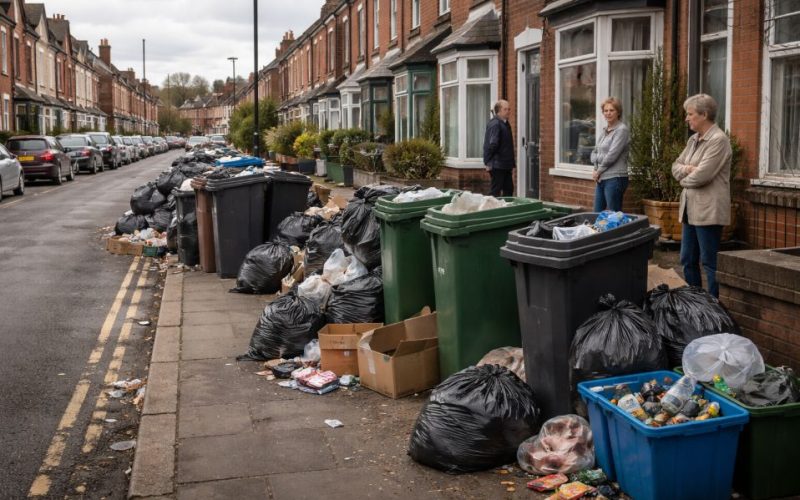
The impact of the Birmingham bin strike has been most visible in changes to waste collection schedules.
While some collections continue, services have been disrupted in several neighbourhoods. Residents have reported delayed collections, temporary suspensions of certain waste categories, and increased reliance on recycling centres.
Current Collection Status (March 2026)
| Waste Type | Current Status | Recommended Action |
|---|---|---|
| General Waste | Alternate Weeks | Use local drop-off points |
| Recycling | Paused in some areas | Store recyclables indoors |
| Garden Waste | Suspended | Consider home composting |
Waste management professionals warn that extended disruptions may lead to increased pressure on recycling centres and local waste disposal systems.
What Do Experts Say About the Birmingham Bin Strike?
 Industry experts and local government analysts say the Birmingham bin strike 2026 has become one of the most closely watched municipal labour disputes in the UK.
Because Birmingham is one of the largest cities in the country, any prolonged disruption to waste services can attract national attention.
One waste management consultant explained:
The Numbers Behind the Disruption
Early estimates suggest the strike affects a large portion of Birmingham’s population.
Key figures often cited in reports include:
- Hundreds of thousands of households relying on city waste collection
- Thousands of tonnes of waste generated weekly
- Large operational teams involved in waste collection services
Although exact numbers change week by week, experts say the scale of Birmingham’s waste system makes any prolonged disruption significant.
How Can Residents Manage Household Waste During the Strike?
During the Birmingham bin strike, residents may need to adapt how they manage waste temporarily.
Small adjustments can help reduce inconvenience and avoid overflowing bins.
Examples include:
- Reducing unnecessary packaging waste
- Compressing rubbish before disposal
- Storing recyclables separately until services resume
A waste management advisor suggests:
Where Are Birmingham’s Active Household Waste Recycling Centres?
For residents needing immediate disposal options, several Household Waste Recycling Centres (HWRCs) remain operational.
These sites allow residents to dispose of certain waste types during service disruptions.
Map of Active Household Waste Recycling Centres (HWRCs)
Key centres include:
- Tyseley Household Recycling Centre
- Perry Barr Household Recycling Centre
- Lifford Lane Household Recycling Centre
Residents may be required to:
- Book visits in advance
- Follow site capacity rules
- Separate waste materials before arrival
Checking local guidance before travelling to a centre is recommended.
Why Might the Missed Bin Reporting Portal Be Disabled?
 Many residents have noticed that the missed-bin reporting system may be temporarily unavailable during strike periods.
This usually happens because missed collections are linked to industrial action rather than operational problems.
Local councils often disable reporting tools to avoid processing thousands of automated reports related to the strike.
Instead, councils provide updates through official service pages and local announcements.
What Could Happen When the Strike Reaches September?
The current plan for the Birmingham bin strike is to continue until September 2026, but negotiations could change the timeline.
Several possible scenarios may occur:
Negotiated Settlement
Both parties could reach an agreement addressing pay concerns and restructuring proposals.
Government Mediation
In some industrial disputes, external mediators help facilitate negotiations.
Extended Industrial Action
If negotiations fail, the dispute could continue beyond September.
Industrial relations experts often note that long-running disputes typically conclude through gradual compromise rather than immediate resolution.
What Lessons Could Other UK Councils Learn From the Birmingham Bin Strike?
Municipal labour disputes often provide insights for other local authorities.
The Birmingham bin strike 2026 may influence how councils across the UK approach service restructuring and workforce negotiations.
Policy analysts suggest that councils may increasingly focus on:
- Transparent communication with staff
- Gradual operational reforms
- Early negotiation with unions
A public policy researcher commented:
Conclusion
The Birmingham bin strike 2026 highlights the complex relationship between local government finances, workforce concerns, and essential public services.
While workers have voted to extend industrial action until September 2026, negotiations remain ongoing between Unite the Union and Birmingham City Council.
For residents, the key priority is staying informed and adapting temporarily to changes in waste collection schedules.
As discussions continue, the outcome of this dispute may influence how councils across the UK manage public services and labour negotiations in the future.
Bookmark London Local News for regular updates on the Birmingham Bin Strike 2026 and wider UK industrial action developments.
FAQs About the Birmingham Bin Strike
When will the Birmingham bin strike end?
Following the latest vote, industrial action is currently expected to continue until September 2026, unless an agreement is reached earlier.
Why are Birmingham refuse workers striking?
Workers say the dispute relates to pay fairness, role restructuring, and working conditions.
Are Birmingham bins still being collected?
Some waste collections continue, but services may be reduced or delayed depending on staffing levels.
Can residents take rubbish to recycling centres?
Yes, several Household Waste Recycling Centres remain open and accept household waste.
Can residents claim a Council Tax refund due to the strike?
Council Tax is legally defined as a tax rather than a service charge, meaning refunds are rarely issued.
What should residents do with recycling during the strike?
Residents can store recyclables in dry containers until collection services resume.
Could the strike end earlier than September?
Yes. If negotiations succeed before September, the strike could end sooner.