



Table of Contents Show
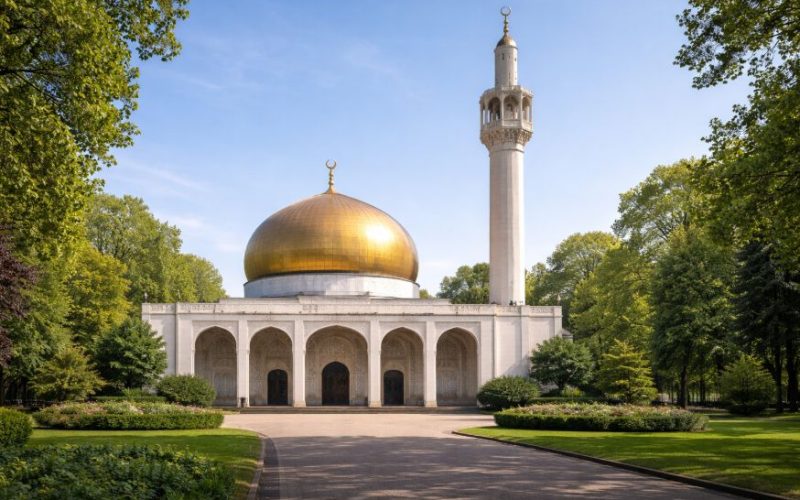
Situated near the heart of the capital, the Regent Mosque in London officially known as the London Central Mosque—stands as one of the most recognisable symbols of Islamic presence in the United Kingdom. Its location beside Regent’s Park, architectural elegance, and role within the British Muslim community make it a landmark of religious, cultural, and historical importance.
As both a place of worship and an educational centre, the mosque plays a vital role in promoting interfaith dialogue and fostering social cohesion in one of the most diverse cities in the world. Whether for daily prayers, Friday congregational services, or public lectures, the mosque continues to attract thousands of worshippers and visitors every week.
For those looking to understand more about Islam’s place in British society or simply to appreciate a fine example of Islamic architecture the Regent’s Park Mosque offers an experience that is welcoming, enlightening, and deeply rooted in London’s multicultural fabric.
What Makes the Regent Mosque a Landmark in London?
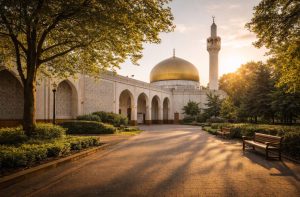
 Located next to the green expanse of Regent’s Park, the Regent Mosque in London, formally known as the London Central Mosque, is a significant religious and cultural landmark in the UK.
It serves as a focal point for Muslims living in and visiting London while also acting as a bridge between Islamic culture and British society. With its distinctive golden dome and peaceful surroundings, the mosque welcomes thousands of visitors each year, both for worship and for cultural exploration.
The mosque isn’t only a spiritual centre; it’s also a space where communities gather, tourists learn, and people of different faiths engage in mutual understanding. Its presence highlights the rich religious diversity within Britain and reflects the evolution of Islam as part of the UK’s social fabric.
How Did the Regent Mosque Come to Be?
The roots of the London Central Mosque stretch back to the early 20th century. The growing Muslim population in London needed a formal space for religious practice, and the idea for a central mosque became a matter of public and political interest. In a historic gesture of support, King George VI donated land in 1940 for the development of a mosque, located in the prestigious Regent’s Park area.
Shortly after, in 1944, the Islamic Cultural Centre (ICC) was inaugurated, laying the groundwork for future religious and cultural development. The current mosque structure, however, wasn’t built until the 1970s, with British architect Sir Frederick Gibberd leading its design.
The final structure, completed in 1977, was created with both Islamic and contemporary British influences, marking a milestone in the architectural and religious landscape of the UK.
Since its opening, the mosque has evolved into one of the most recognised Islamic institutions in Western Europe, playing a crucial role in interfaith engagement, education, and community support.
What Are the Architectural Highlights of the Mosque?
The architectural design of the Regent’s Park Mosque is one of its most admired features. The mosque’s design fuses Islamic tradition with modern British architectural elements, creating a structure that is both spiritually meaningful and visually striking.
The most noticeable feature is the large golden dome, which can be seen from various points around Regent’s Park. A single minaret stands tall beside it, completing the silhouette that defines the building’s exterior.
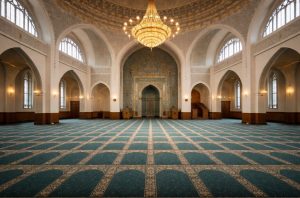
Inside, the mosque houses a spacious prayer hall that can accommodate over 5,000 worshippers. The hall is covered in a richly patterned carpet, with rows aligned toward the mihrab, the niche indicating the direction of Mecca.
The ceilings are adorned with Arabic calligraphy and geometric motifs, all illuminated by soft natural light that filters through stained glass windows.
Beyond aesthetics, the architectural layout promotes tranquillity and reflection. It was designed not only as a place for prayer but also as a symbol of unity and dignity for the Muslim community in Britain.
What Services and Programmes Are Available at the Mosque?
 The London Central Mosque offers a broad range of services that extend well beyond the daily prayer schedule. At the heart of its operations is its commitment to religious, educational, and social development. Regular five daily prayers are held in the main prayer hall, with special emphasis on Friday (Jumu’ah) prayers, which draw large congregations from across the city.
In addition to worship, the mosque runs Islamic education classes, including Quranic studies for children, Arabic language courses, and adult learning programmes.
There are also public lectures, workshops, and interfaith seminars that welcome attendees of all backgrounds. The attached Islamic Cultural Centre supports these efforts through event planning and educational outreach.
Furthermore, the mosque provides services such as marriage ceremonies, funeral arrangements, and counselling, making it an essential hub for the community’s spiritual and everyday needs.
What Should Visitors Know Before Visiting the Mosque?
Visitors to the Regent’s Park Mosque are greeted with a welcoming and peaceful atmosphere. The mosque is open to the public throughout the week, though Friday afternoons and Islamic holidays tend to be the busiest times. Non-Muslim visitors are encouraged to come and learn about Islam, either through guided tours or by exploring the building and its surroundings independently.
Modest dress is expected. Men should wear long trousers, and women are encouraged to wear clothing that covers their arms and legs, along with a headscarf. Shoes must be removed before entering prayer areas. Visitors are also advised to maintain respectful behaviour, particularly during prayer times.
The mosque is easily accessible by public transport, with Baker Street and Regent’s Park stations just a short walk away. For those arriving by car, limited parking is available, but it is recommended to use public transport during peak times.
How Does the Mosque Support the Wider British Muslim Community?
The mosque plays a central role in the lives of British Muslims, serving not just as a place of worship but also as a cultural and educational institution. Through the Islamic Cultural Centre, it organises events that aim to promote better understanding of Islamic teachings and practices. These include seminars, exhibitions, interfaith conferences, and charity initiatives.
By offering a platform for religious expression, the mosque helps preserve Islamic traditions while also fostering integration into British society. Its role in interfaith dialogue is particularly significant, as it regularly invites leaders from other religions to share in discussions about peace, ethics, and community welfare.
Moreover, during major Islamic festivals like Eid al-Fitr and Eid al-Adha, the mosque hosts thousands of worshippers and often provides meals, charity drives, and family-friendly events that enhance its role as a true community space.
What Do Visitors Say About Their Experience?
 Reviews from platforms such as Google Reviews consistently highlight the mosque’s architectural beauty, serene environment, and welcoming atmosphere. Many visitors note that their experience was not only spiritually enriching but also educational.
One review describes the space as “immaculately maintained and deeply peaceful,” while another praises the staff for being informative and respectful, especially during tours. Some tourists, visiting for cultural learning, mention that the guided experiences helped them understand aspects of Islam they hadn’t previously encountered.
These first-hand accounts reinforce the mosque’s role as an open, respectful, and inclusive space, in line with the values of modern, multicultural Britain.
How Does the Regent Mosque Compare to Other UK Mosques?
To understand the scale and uniqueness of the Regent Mosque, it helps to compare it with other major mosques across the UK:
| Feature | Regent’s Park Mosque | East London Mosque | Birmingham Central Mosque |
| Location | London (NW8) | London (E1) | Birmingham (B12) |
| Capacity | ~5,000 worshippers | ~7,000 | ~6,000 |
| Built | 1970s | 1980s | 1970s |
| Facilities | Library, ICC, school | School, events hall | Youth centre, library |
| Architecture | Traditional Islamic | Modern/Islamic fusion | Traditional Islamic |
Each mosque plays a vital role in its respective city, but the Regent Mosque’s historic location, state-level support, and interfaith outreach make it uniquely prominent in both religious and cultural contexts.
How Has the Regent Mosque Shaped Islam’s Presence in Britain?
The establishment of the Regent Mosque marked a turning point in the public recognition of Islam as part of British life. It was among the first large-scale Islamic institutions to gain official support and has since paved the way for other mosques across the UK.
Through its educational and outreach work, the mosque has contributed to public understanding of Islamic values, as well as promoting integration, dialogue, and tolerance. Over the decades, it has hosted numerous religious leaders, politicians, and dignitaries, becoming a key player in representing British Muslims on the national stage.
Today, it continues to reflect the diverse nature of Islam in the UK, attracting worshippers from a wide range of ethnic backgrounds and fostering a spirit of unity.
FAQs About the Regent Mosque in London
What is the difference between the Regent’s Park Mosque and the Islamic Cultural Centre?
The mosque is the place of worship, while the ICC is the adjoining organisation that offers educational and community services.
Is the Regent Mosque open to non-Muslims?
Yes, visitors of all backgrounds are welcome, provided they respect the dress code and prayer times.
Are tours available for schools or tourists?
Yes, guided tours are available upon request and are especially popular with schools and cultural groups.
What facilities does the mosque offer?
Facilities include a prayer hall, library, classrooms, ablution areas, and a cafeteria.
When is the best time to visit?
Weekdays outside of prayer times offer the most peaceful and informative experience.
Is photography allowed inside the mosque?
Photography may be allowed in certain areas but should always be done respectfully and never during prayers.
Can I attend Friday prayers as a visitor?
Yes, but it is advisable to arrive early due to large attendance.